
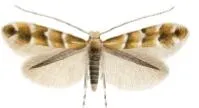
Insect
Horse-chestnut leaf miner: where to see it
Cameraria ohridella
Invasive alien in some territories
Listed as invasive alien for: France, Poland, Austria, Switzerland, Croatia, Belgium, Netherlands, Czechia, Slovakia, Slovenia, Romania, Denmark, Ireland, Luxembourg, United Kingdom, Sweden, Norway, Estonia, Latvia, Serbia, Bosnia and Herzegovina, Türkiye (GRIIS).
This insect species is recorded in 2 protected areas of the atlas. Within the atlas countries, it is mostly observed in the Netherlands, the United Kingdom and Germany (4 countries in all). Most records (8 in 10) lie between sea level and 600 m. Records peak from July to September.
Best time to see it: July–September
Records published on GBIF by month (CC0 and CC BY 4.0 licences only), in the atlas countries, all years combined; they also reflect observer activity.
Distribution
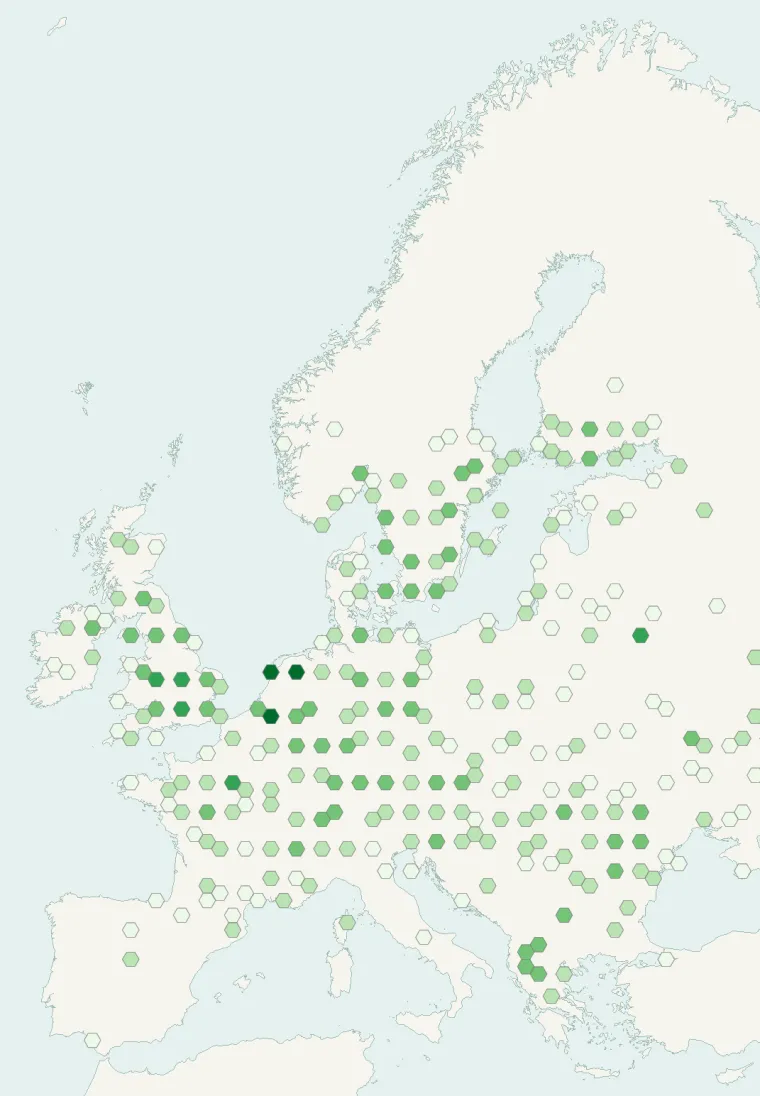
Records published on GBIF (CC0 and CC BY 4.0 licences): the darker the shade, the more records there are; they also reflect observation effort.
Atlas countries where it is recorded
From Wikipedia
The horse-chestnut leaf miner (Cameraria ohridella) is a leaf-mining moth of the family Gracillariidae. The horse-chestnut leaf miner was first observed in North Macedonia in 1984, and was described as a new species in 1986. Its larvae are leaf miners on the common horse-chestnut (Aesculus hippocastanum). The horse-chestnut leafminer was first collected and inadvertently pressed in herbarium sheets by the botanist Theodor von Heldreich in central Greece in 1879.
Source: Wikipedia, article “Horse-chestnut leaf miner” (version of September 15, 2026) · history and authors · licence CC BY-SA 4.0
Protected areas where it is recorded
1,300 records

6 records
Other species to discover
Sources and credits
- Presence: most-recorded species of each place on GBIF and species of Community interest in the Natura 2000 forms (EEA, CC-BY 4.0); absence from the list does not mean the species is absent.
- Common names: Wikidata (CC0) and GBIF.
- Photos and sounds: Wikimedia Commons, author and licence given for each file.
- Classification: GBIF Backbone Taxonomy (GBIF Secretariat), CC BY 4.0, doi:10.15468/39omei.
- Countries, elevations, months and maps: GBIF.org, CC0 or CC BY 4.0 occurrences only, accessed October 23, 2026, GBIF.org.
- Base map: Natural Earth (public domain).
- Excerpt: Wikipedia, CC BY-SA 4.0 (full credit below the excerpt).
- Invasive alien species: Union list, Regulation (EU) No 1143/2014 (INBO, CC0); Global Register of Introduced and Invasive Species (ISSG, CC BY 4.0).