
Features ·
Natural parks in Chile
From the Atacama Desert to Cape Horn, Chile protects 46 national parks within a network of 110 state-protected wild areas covering 18.8 million hectares, or 21% of its territory, according to the National Forest Corporation (CONAF). This article traces their history, from the Malleco forest reserve in 1907 to the 2023 law that hands the parks over to a new public agency, and reviews their status, their management and the challenges ahead.
What counts as a natural park in Chile?
In Chile, the term “natural park” is not a legal category. Public protected areas make up the Sistema Nacional de Áreas Silvestres Protegidas del Estado (SNASPE), the National System of State-Protected Wild Areas, administered since the 1970s by the Corporación Nacional Forestal (CONAF). It comprises three categories: parques nacionales (national parks), reservas nacionales (national reserves) and monumentos naturales (natural monuments). The fourth category provided for by the Washington Convention, the reserva de región virgen (virgin region reserve), has never been used.
Law 21.600 of 2023 provides the first legal definition of a national park actually in force, since the one in Law 18.362 of 1984 never took effect. Its Article 58 describes it as “a terrestrial, aquatic, marine, insular or continental area, generally extensive,” intended to preserve the natural heritage, its scenic or cultural value and the continuity of evolutionary processes, and specifies that the exploitation of natural resources for commercial purposes is prohibited there. The Chilean national park thus matches the international idea of a national park: a large natural area withdrawn from exploitation and open to research, education and tourism.
Chile has no equivalent of the French regional nature parks (parcs naturels régionaux), inhabited areas organized around a shared territorial project. Complementary roles are played by other designations: the reserva nacional, where sustainable use of resources is allowed; the santuarios de la naturaleza (nature sanctuaries), which often protect smaller and sometimes private sites; and private protected areas, which are highly developed in Patagonia. Law 21.600 also creates two new categories, the multiple-use conservation area and the Indigenous peoples' conservation area.
History: from the 1907 forest reserves to the Servicio de Biodiversidad
Chile's first nature protection measures were forestry measures. A law on timber cutting was passed in 1872, and a decree of January 16, 1879, provided for reserves of state-owned forests in the provinces of Arauco, Valdivia and Llanquihue, as well as in the department of Angol.
On September 30, 1907, a supreme decree created the Reserva Forestal Malleco, in what is now the Araucanía Region. It was the Chilean state's first protected area, and September 30, the anniversary of its creation, is now National Park Ranger Day; National Protected Areas Day is set by law on the second Saturday of November. According to the Library of the National Congress (Biblioteca del Congreso Nacional, BCN), the reserve was intended to regulate the timber trade and protect soil and water. A 2013 CONAF institutional publication presents it as the third protected area in Latin America. In the early 1910s, the state created the General Inspectorate of Forests, Fisheries and Hunting and established new forest reserves, notably at Villarrica, in the upper Biobío and at Llanquihue. The German-born naturalist Federico Albert (1867–1928) played an active part in this movement in favor of reforestation and conservation.
The national park idea arrived in 1925. That year, Decree-Law 656 of October 17, 1925, the first forest law, was promulgated and a first national park was created: Benjamín Vicuña Mackenna National Park, named after the 19th-century historian and politician. It did not last: it was disestablished in 1929. The title of oldest national park still in existence therefore goes to Vicente Pérez Rosales National Park, created on August 17, 1926, by Supreme Decree 552 of the Ministry of Lands and Colonization. Surrounding Lake Todos los Santos and Osorno Volcano, in the Los Lagos Region, it celebrated its centenary in August 2026.
The forest law, whose final text was set by Decree 4.363 of July 31, 1931, gave the President of the Republic the power to create “national tourism parks” and forest reserves on state land, linking conservation with scenic value and tourism. New parks multiplied. On January 16, 1935, Supreme Decree 103 designated Easter Island (Rapa Nui National Park) and the Juan Fernández Archipelago as national parks. Between 1935 and 1945, according to the BCN, the network gained a dozen units. Progress was not linear, however: in the same year, 1935, Colonization Law 5.604 allowed settlers, in certain cases, to establish themselves in forest reserves and national parks.
Next came some of the country's best-known parks: Villarrica (1940), Conguillío (1950, around Llaima Volcano and its araucaria forests), then, in 1959, Laguna San Rafael in Aysén and, on May 13, by Supreme Decree 383 of the Ministry of Agriculture, the Lago Grey National Tourism Park, covering barely 4,332 ha, in Magallanes, which would become Torres del Paine National Park. The international framework took shape: the Convention on Nature Protection and Wild Life Preservation in the Western Hemisphere, signed in Washington on October 12, 1940, entered into force in Chile in 1967 through Supreme Decree 531 of the Ministry of Foreign Affairs. It defines the categories of protected areas and still serves as the legal basis for creation decrees. The same year, La Campana National Park, near Valparaíso, was created by statute, Law 16.699 of October 17, 1967. In 1969, Bernardo O'Higgins National Park was created over the glaciers and fjords of Patagonia; it would become the country's largest. Lauca National Park, on the altiplano of the far north, dates from 1970.
The 1970s laid down the current institutional architecture. The Corporación de Reforestación (COREF) was established on May 13, 1970. By a decree of April 19, 1973, published on May 10, under the government of Salvador Allende, it became the Corporación Nacional Forestal (CONAF), which was given responsibility for protected areas. Unusually, CONAF is a private-law corporation attached to the Ministry of Agriculture. Also in 1970, Law 17.288 on national monuments created the category of nature sanctuaries. Between 1970 and 1974, twelve more national parks and three national reserves were created, according to Memoria Chilena. Decree-Law 1.939 of 1977 gave the Ministry of National Assets (Bienes Nacionales) the power to assign state land to conservation, and most of the recent parks would be created by its decrees. UNESCO recognized its first biosphere reserves in Chile: Fray Jorge and Juan Fernández in 1977, Torres del Paine in 1978, Laguna San Rafael in 1979 and Lauca in 1981.
In 1984, the military regime had Law 18.362 passed, published on December 27, 1984, which formally created the SNASPE and its four categories. But its entry into force was made conditional on CONAF being turned into a public body, as provided for by another law that never took effect. Law 18.362 therefore never came into force. For nearly forty years, the system operated on the basis of the Washington Convention, Decree-Law 1.939 and, from 1994, Law 19.300 on the General Bases of the Environment, which requires the state to administer a national system of protected areas and to encourage private protected areas. At the end of the 1980s, the SNASPE comprised 29 national parks, 36 national reserves and 9 natural monuments, about 14 million hectares in all, managed by 269 park rangers for some 600,000 visitors a year, according to Memoria Chilena. In 1995, Rapa Nui National Park was inscribed on the UNESCO World Heritage List.
From 1990, a private actor changed the scale of conservation in Patagonia: the American Douglas Tompkins, co-founder of The North Face, bought vast estates to create the private Pumalín park, and then, with his wife Kristine Tompkins, other properties in Aysén and Magallanes. Part of this land was donated to the state: in 2013, Yendegaia National Park, in Tierra del Fuego, combined state land with 38,780 ha donated by the Tompkins family, according to CONAF. After Douglas Tompkins's death in 2015, President Michelle Bachelet and Kristine Tompkins signed a memorandum of understanding on March 15, 2017: the foundations donated 407,625 ha, while the state contributed 949,368 ha of state land and reclassified reserves as national parks. According to the government of the time, the project covered eight areas and about 4.5 million hectares. The decrees followed: Pumalín Douglas Tompkins National Park (decree of February 28, 2018, published on August 9, 2018, 402,392 ha), Patagonia National Park (decree of December 11, 2018, 304,528 ha, formed from the former Jeinimeni and Tamango reserves and the Chacabuco Valley donated by the Tompkins), Melimoyu National Park, the reclassification of the Cerro Castillo reserve as Cerro Castillo National Park (2018) and Kawésqar National Park, created by a decree of January 2018 published on January 30, 2019, which brings together, over 2,842,329 ha, the former Alacalufes forest reserve, state land and a property donated by the Tompkins.
The creations that followed were mostly reclassifications and parks close to cities or in ecosystems that had been poorly protected until then. The Río Clarillo reserve became Río Clarillo National Park, the first national park in the Santiago Metropolitan Region (decree published on December 17, 2020), and the Nonguén reserve, near Concepción, became Nonguén National Park by a decree of April 5, 2021. In 2023, three parks were published in the Diario Oficial (Official Gazette): Salar del Huasco on the Tarapacá altiplano (March 1), Desierto Florido in the Atacama Region (June 12), to protect the flowering desert phenomenon, and Glaciares de Santiago in the Andes above the capital (August 16).
The same year saw the completion of a reform awaited for more than thirteen years. Law 21.600, promulgated on August 21, 2023, and published on September 6, 2023, created the Servicio de Biodiversidad y Áreas Protegidas (SBAP, Biodiversity and Protected Areas Service), a public agency under the Ministry of the Environment, and the Sistema Nacional de Áreas Protegidas (SNAP, National Protected Areas System), which brings together public and private, terrestrial and marine areas. It repeals Law 18.362. It is being implemented gradually. According to the Diario Oficial, the service legally began functioning on March 9, 2024, with the publication of its first decree with force of law, and began operations on February 1, 2026. Under the law, the transfer of CONAF staff assigned to protected areas must take place within three years of the service beginning to function, that is, by March 8, 2027, at the latest. A decree of March 3, 2026, had set it for August 1, 2026; on July 15, 2026, a new decree of the Ministry of the Environment revoked it, after the director of the SBAP indicated that the service did not have the capacity to take on the staff by that date. The SBAP and CONAF have announced that the transfer will take place from March 2027. In parallel, Law 21.744, published on May 23, 2025, creates the Servicio Nacional Forestal (SERNAFOR, National Forest Service), CONAF's legal successor, while management of the protected areas passes to the SBAP.
Legal framework
Chilean park law now rests on several layers of legislation. The 1940 Washington Convention, in force since Supreme Decree 531 of 1967, provides the basic definitions. Decree-Law 1.939 of 1977 allows the Ministry of National Assets to assign state land to conservation. Law 19.300 of 1994, as amended by Law 21.600, provides in Article 34 that the state administers a National Protected Areas System entrusted to the SBAP, and in Article 35 that the state encourages private protected areas, which form part of that system.
Law 21.600 of 2023 is now the central text. It establishes six categories (Article 56): virgin region reserve, national park, natural monument, national reserve, multiple-use conservation area and Indigenous peoples' conservation area. It prohibits the commercial exploitation of resources in national parks (Article 58), which includes extractive activities and industrial infrastructure (Article 63), and prohibits the corresponding sectoral concessions in virgin region reserves, national parks and natural monuments (Article 93). It requires a management plan within two years of an area's creation, reviewed at least every five years (Article 73). Its transitional articles organize the takeover of the areas managed by CONAF and the reclassification of existing areas, including nature sanctuaries, into the new categories, within five years of the service beginning to function.
Other texts complete the framework: Law 17.288 of 1970 on national monuments (nature sanctuaries), Law 20.417 of 2010, which created the Ministry of the Environment, Law 20.930 of 2016 on the real right of conservation (derecho real de conservación), which allows a landowner to place a lasting encumbrance on their land for conservation purposes, and the General Fisheries Law, the basis for marine parks and reserves.
Types of parks and protected areas
The national park is the most protective category among those actually in use. It covers large, representative areas where only research, education and recreation are allowed.
The national reserve allows sustainable use of resources, particularly forest resources, under the manager's supervision. Malleco, the oldest protected area, is one. The natural monument protects a specific site or feature, often small in area: a geological formation, an archaeological site or a population of a species. It should not be confused with the declaration of certain tree species as a “natural monument,” which prohibits felling them, as with the alerce (1976) or the araucaria (decree of 1990).
Outside the SNASPE, the nature sanctuary, created by Law 17.288 of 1970, protects terrestrial or marine sites of particular interest for study and research. It may be public or private; since 2010, sanctuaries have been declared by decree of the Ministry of the Environment. According to an educational booklet published by the National Monuments Council in 2021, the country then had 63 nature sanctuaries covering 581,249 ha; others have been declared since. Recent declarations include Cruz de Piedra, about 93,000 ha in San José de Maipo, declared a sanctuary by a decree published in November 2023.
Private protected areas are a distinctive pillar of the Chilean model. A survey carried out for the Ministry of the Environment in 2013–2015, as part of a Global Environment Facility project, counted 308 private conservation initiatives covering about 1.6 million hectares. Law 21.600 allows them to join the national system officially at the owner's request, by decree, with tax benefits (exemption from property tax and inheritance tax as long as the management plan is complied with).
Finally, at sea, Chile has created marine parks, marine reserves and multiple-use marine and coastal protected areas (AMCP-MU), which so far fall under fisheries law and the Ministry of the Environment.
How many parks?
According to CONAF's “Nuestros Parques” page, consulted on November 2, 2026, CONAF administers 110 state-protected wild areas: 46 national parks, 45 national reserves and 19 natural monuments, covering 18.8 million hectares, or 21% of the national territory. CONAF also manages three nature sanctuaries.
The latest breakdown by category published by CONAF, in August 2023, gave 46 national parks covering 13,452,119 ha, 45 national reserves covering 5,375,935 ha and 18 natural monuments covering 34,357 ha, for a total of 18,862,410 ha according to CONAF and 21.46% of the territory. National parks alone therefore account for more than 70% of the system's area. No new national park has been published since Glaciares de Santiago, in August 2023.
This area is very unevenly distributed. According to a study by the Terram Foundation (Fundación Terram) based on January 2020 data, the Los Lagos, Aysén and Magallanes regions account for 90.7% of the SNASPE's area, while the center of the country, the most populated part, is poorly protected.
Map
The Parkavela atlas presents Chile's national parks on the Chile page, with their map, and on the world map of protected areas. The parks stretch over more than 4,000 km, from the altiplano of Arica y Parinacota to the islands of Cape Horn, plus the island parks of Rapa Nui and Juan Fernández in the Pacific.
Complete list
The list of Chilean national parks described in the atlas, each with its detailed page, is available in the directory of Chile's national parks. The official list of parks, reserves and natural monuments is published by CONAF on its website, and the Ministry of the Environment's register of protected areas, part of the SIMBIO platform, also lists sanctuaries and marine areas.
How a park is created
Until Law 21.600 is fully applied, most national parks have been created by supreme decree of the Ministry of National Assets on state land, under Decree-Law 1.939 and the Washington Convention. The procedure includes the favorable opinion of the Council of Ministers for Sustainability, a legality review by the Contraloría General de la República (Comptroller General of the Republic), known as the “toma de razón,” and publication in the Diario Oficial. The steps can take a long time: the decree for Kawésqar park, dated January 2018, was not published until January 2019.
Law 21.600 now sets out the procedure (Articles 64 and 65): state protected areas are created by supreme decree of the Ministry of the Environment, co-signed by the Minister of National Assets when state land is involved. The SBAP prepares a technical report; the procedure includes public participation, consultation of regional governments and municipalities, consultation of the Indigenous peoples concerned in accordance with ILO Convention 169, and the favorable opinion of the Council of Ministers for Sustainability and Climate Change. Under Article 66, a national park or a virgin region reserve can be modified or disestablished only by law.
Private donations play an important role: the Tompkins foundations handed over their land on condition that the state designate it a national park within a set period, and the Rewilding Chile foundation transferred its land at Cabo Froward with a view to creating a national park, under a memorandum signed with the state in 2024.
Managing agencies
CONAF, attached to the Ministry of Agriculture, has managed national parks, national reserves and natural monuments since 1973 through its protected wild areas program. Its park rangers (guardaparques) carry out surveillance, visitor services, maintenance and scientific monitoring; about 500 staff are due to be transferred to the SBAP.
The SBAP, created by Law 21.600 and attached to the Ministry of the Environment, has been operational since February 1, 2026. It is due to take over the management of parks, reserves and natural monuments from March 2027, and oversees private protected areas. The Ministry of the Environment declares nature sanctuaries and marine areas. The Ministry of National Assets remains the owner of state land. Marine areas are monitored by the National Fisheries Service (Sernapesca).
Some parks have their own managers. Under a decree of November 2017, Rapa Nui National Park has been granted in concession for 50 years to the Ma'u Henua Indigenous community, which represents the Rapa Nui people. The Rapa Nui marine area is run by a council made up of six representatives elected by the Rapa Nui people and five representatives of the state.
Funding
Funding relies on the state budget and on the parks' own revenue, mainly entrance fees and concessions. According to the Terram Foundation's analysis of the 2026 budget bill, CONAF's protected wild areas program receives 23,100 million pesos, including 12,677 million in operating revenue: the direct budget contribution accounts for only about 45% of the total. The same bill allocates 17,393 million pesos to the SBAP for its first year of operations.
Law 21.600 provides that the SBAP collects the entrance fees for state protected areas and the revenue from concessions and permits (Article 10), and creates a National Biodiversity Fund (Article 46), financed by the budget, donations and bequests, intended to fund conservation projects mainly outside state protected areas. Philanthropy has played a major role: the donations under the 2017 Tompkins agreement alone amount to 407,625 ha.
Missions
The primary mission of national parks is to preserve ecosystems and landscapes and the continuity of ecological and evolutionary processes. Law 21.600 assigns broader objectives to the national system: effective conservation of biodiversity and the associated natural, landscape and cultural heritage; representation of all ecosystem types; maintenance of ecosystem services; ecological connectivity through corridors and buffer zones; participation of local communities and Indigenous peoples; recognition of Indigenous and local knowledge; and monitoring of climate change.
To these are added visitor services, environmental education and research. CONAF has, for example, deployed camera traps in 32 units, more than 1,000 cameras at over 1,500 monitoring points, according to its August 2023 review.
Regulations
In a national park, the commercial exploitation of natural resources is prohibited: no mining, logging or industrial infrastructure. Permitted activities are research, education, recreation and tourism, within the limits set by the management plan, which divides the park into use zones. In parks made up exclusively of marine ecosystems, only research, education and small-scale tourism are allowed.
For visitors, the basic rules are paid entry in many units, the obligation to stay on trails and in authorized camping areas, and bans on lighting fires outside designated places, picking plants, hunting and bringing in animals. Trails and boat services on some lakes may close in winter: in May 2026, for example, CONAF announced the temporary closure of the W Trek in Torres del Paine for the winter season.
Local life and economic activity
Chile's national parks have few inhabitants, but they support many neighboring communities: guides, transport operators, accommodation providers, restaurant owners. Within the parks, CONAF entrusts some services (refuges, campsites, boat trips, catering) to private concessionaires.
Indigenous peoples are directly concerned: Rapa Nui park is managed by the Ma'u Henua community, which collects the entrance fees, and the creation of the Kawésqar park and reserve, in the ancestral territories of the people of the same name, was accompanied by an Indigenous consultation. In the inland waters of Patagonia, the coexistence of salmon farming and protected areas is a source of conflict: Kawésqar National Reserve, whose decree allows productive activities at sea, hosts dozens of salmon farming concessions granted before its creation, and in 2024 the Contraloría ruled that new ones must be compatible with its management plan, which is still being drawn up.
Tourism
According to CONAF, the state-protected wild areas received 2,271,929 visitors in 2022, 92.84% of them Chilean and 7.16% foreign. Vicente Pérez Rosales National Park, on the doorstep of Puerto Varas, received 365,834. Torres del Paine, the Chilean park best known abroad, attracts a mainly international clientele, with about 380,000 visitors in the 2024–2025 season, mostly foreigners, according to press reports.
Hiking is the flagship activity: the W Trek and the O Circuit in Torres del Paine, the volcanic trails of Villarrica, Conguillío and Puyehue, and the alerce forests of Alerce Andino and Alerce Costero. The Ruta de los Parques de la Patagonia (Route of Parks of Patagonia), promoted by the Rewilding Chile foundation, offers a route of more than 2,800 km linking 18 national parks since Vicente Pérez Rosales joined it in October 2026, from Puerto Varas to Cape Horn, along the Carretera Austral and the channels. Safety remains a concern: in November 2025, five foreign hikers died in a snowstorm on the O Circuit in Torres del Paine, prompting the authorities to review their protocols.
Biodiversity
Stretching over more than 4,000 km and isolated by desert, the Andes and the ocean, Chile is home to highly varied ecosystems and a flora rich in endemic species. Its central zone, with a Mediterranean climate, and the Valdivian temperate forests form one of the world's biodiversity hotspots recognized by the Critical Ecosystem Partnership Fund.
The parks cover most of these environments: the altiplano and its salt lagoons (Lauca, Volcán Isluga, Salar del Huasco), the coastal desert and its fogs (Pan de Azúcar, Bosque Fray Jorge, Desierto Florido), the matorral and palm groves of the center (La Campana), the araucaria forests (Nahuelbuta, Conguillío), the Valdivian rainforest (Puyehue, Vicente Pérez Rosales, Chiloé), the ice fields and fjords of Patagonia (Laguna San Rafael, Bernardo O'Higgins, Kawésqar) and the Patagonian steppe (Patagonia, Pali Aike). The system also protects a large share of the country's glaciers: according to a study published in a University of Chile journal, the SNASPE includes 43% of Chile's glaciers and 83% of its glacier-covered area.
Representation remains uneven: most of the large parks are in Patagonia, while the matorral and sclerophyllous forests of the center, where population and agriculture are concentrated, are poorly represented.
Flagship species
The Andean condor and the huemul, an Andean deer listed as Endangered by the IUCN, appear on Chile's coat of arms. The huemul survives in the forests and valleys of Patagonia; CONAF describes it as an “emblematic species of Chile” in Patagonia National Park, and the decree creating Pumalín park mentions its presence. The condor soars over both the central cordillera and Torres del Paine.
On the altiplano, Lauca, Volcán Isluga and Salar del Huasco parks are home to the vicuña, the guanaco, the taruca (another Andean deer) and three flamingos: the Chilean flamingo, the Andean flamingo and James's flamingo. The lesser rhea, or Darwin's rhea, called suri in the north and ñandú in Patagonia, ranges over the altiplano and the steppes of Pali Aike and Torres del Paine.
The southern forests are the realm of the pudú, one of the world's smallest deer, the puma, the güiña (a small wild cat), the monito del monte (a tree-dwelling marsupial), the Magellanic woodpecker, the black-throated huet-huet, the austral parakeet and the green-backed firecrown. CONAF reports Darwin's frog, whose male broods the tadpoles in its vocal sac, at Conguillío.
On the coasts, the Magellanic penguin nests in colonies on the shores and islands of Patagonia, the Peruvian pelican and the Humboldt penguin frequent the northern coastline, and the black-browed albatross the southern seas.
Among the trees, the araucaria, a conifer sacred to the Pehuenche, and the alerce, which can live for several thousand years, have both been declared natural monuments. The Chilean wine palm (Jubaea chilensis) is one of La Campana's signature trees.
Major parks
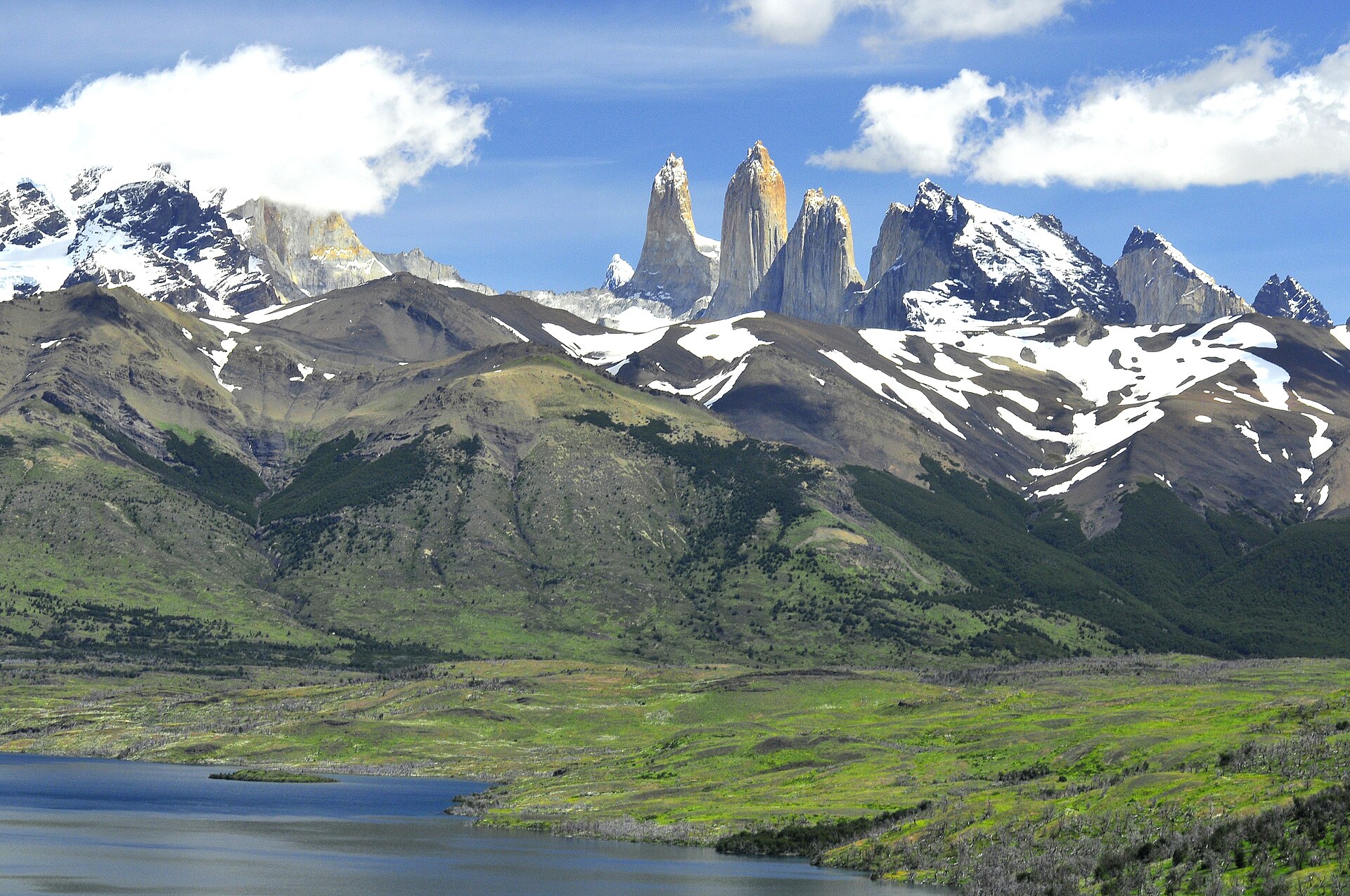
Torres del Paine National Park (1959, 227,298 ha), in Magallanes, is famous for its granite towers, turquoise lakes and glaciers flowing from the Southern Patagonian Ice Field. A biosphere reserve since 1978, it is home to guanacos, rheas, condors and pumas.
Vicente Pérez Rosales National Park (1926, about 253,600 ha), the oldest, surrounds Lake Todos los Santos, the Petrohué Falls and Osorno Volcano.
Lauca National Park (1970, 137,883 ha), on the precordillera and the altiplano, above 3,200 m, includes Lake Chungará (22.5 km²) and its flamingos. A biosphere reserve since 1981.
Rapa Nui National Park (1935, 6,908 ha) protects the moai and archaeological sites of Easter Island; it has been a World Heritage Site since 1995 and is managed by the Ma'u Henua community.
Conguillío National Park (1950, 60,832 ha), in Araucanía, combines a volcano, lava flows and araucaria forests; it is part of the Araucarias Biosphere Reserve, recognized in 1983.
Laguna San Rafael National Park (1959, 1,742,000 ha), in Aysén, encompasses much of the Northern Patagonian Ice Field and the San Rafael Glacier, which calves into a lagoon open to the sea.
Bernardo O'Higgins National Park (1969, 3,525,901 ha), between Aysén and Magallanes, is the country's largest, dominated by the Southern Patagonian Ice Field and its fjords.
Patagonia National Park (2018, 304,528 ha), in Aysén, symbolizes the partnership between the state and the Tompkins foundations; it protects the steppe, the forests of the Chacabuco Valley and the huemul.
La Campana National Park (1967, 8,000 ha), near Valparaíso, protects stands of Chilean wine palm and Mediterranean matorral.
Cabo de Hornos National Park (1945, 63,093 ha) marks the southern tip of the American continent.
Other parks deserve a mention: Queulat and its hanging glacier, Huerquehue and Villarrica in Araucanía, Alberto de Agostini in the Cordillera Darwin, and Llullaillaco National Park, dominated by the volcano of the same name (6,739 m according to CONAF).
Records
- Oldest protected area: the Malleco forest reserve, created on September 30, 1907 (BCN, CONAF).
- Oldest existing national park: Vicente Pérez Rosales, created on August 17, 1926; Benjamín Vicuña Mackenna park, created in 1925, was disestablished in 1929 (BCN).
- Largest national park: Bernardo O'Higgins, 3,525,901 ha (CONAF), ahead of Kawésqar, 2,842,329 ha (creation decree).
- Southernmost: Cabo de Hornos National Park, which CONAF presents as the southernmost protected wild area on the planet.
- Highest peak of the southern Andes: Monte San Valentín, 4,058 m, in Laguna San Rafael park (CONAF).
- Largest marine area: the Rapa Nui multiple-use marine and coastal protected area, about 579,368 km² (2018 decree).
- Most recent national parks: Salar del Huasco, Desierto Florido and Glaciares de Santiago, published in the Diario Oficial in 2023, the last on August 16, 2023.
Threats
Fires are the most visible threat. In Torres del Paine, the fire started by a tourist on December 27, 2011, burned more than 17,600 ha before being brought under control at the end of February 2012; together with the 2005 fire, more than 30,000 ha of the park have been affected, according to a university remote-sensing study. Climate change increases the risk of fire and is causing the glaciers that make the Patagonian parks famous to retreat.
Invasive alien species take a heavy toll. In Tierra del Fuego, the North American beaver, introduced on the Argentine side in 1946 for the fur trade, floods and destroys lenga forests; Chile and Argentina signed an agreement in 2008 to eradicate it and restore the ecosystems. In the Juan Fernández Archipelago, introduced plants and animals threaten a largely endemic flora.
Economic pressures bear on the margins of protected areas: mining projects in the altiplano salt flats, salmon farming in the Patagonian channels, infrastructure. The Sociedad Nacional de Minería (Sonami, National Mining Society) asked for the Desierto Florido park decree to be annulled, then challenged it before the environmental court. Visitor numbers, concentrated on a few sites, are another source of pressure.
Finally, institutional weaknesses are chronic: a modest budget heavily dependent on entrance fees, a limited number of park rangers, outdated management plans, and an uncertain transition between CONAF and the SBAP. In October 2026, the park rangers' unions declared themselves in a “state of alert,” for lack of guarantees on their working conditions after the transfer.
Conservation policies
Chilean conservation relies on expanding the network, on restoration and on the involvement of private and Indigenous actors. Law 21.600 is the main tool: it unifies the management of public and private areas, creates conservation instruments outside protected areas and a funding mechanism, and organizes the reclassification of the older designations.
Chile also draws on its international commitments: the Washington Convention, the Convention on Biological Diversity (in force in 1995), a network of ten UNESCO biosphere reserves, Ramsar sites (the first, Río Cruces, in 1981) and the Kunming-Montreal Global Biodiversity Framework, which aims to protect 30% of land and sea by 2030.
Marine policy has been particularly active since 2010: Motu Motiro Hiva Marine Park around Salas y Gómez Island (2010), Mar de Juan Fernández Marine Park (2018 decree, about 262,000 km²) and the Rapa Nui marine and coastal protected area (2018). More than 40% of the exclusive economic zone is thus protected, about 43% according to the Ministry of the Environment in 2024; the expansion of the Juan Fernández and Nazca-Desventuradas parks, which would have raised this figure to 54%, did not go ahead.
Private conservation is encouraged by Law 20.930 on the real right of conservation and by the tax incentives in Law 21.600. The fight against invasive species relies on dedicated programs, such as the binational beaver eradication project in Tierra del Fuego.
New projects
Several projects were under way when the government changed in March 2026. In March 2026, the Council of Ministers for Sustainability had approved the expansion of the Juan Fernández and Desventuradas Islands marine parks. In the Atacama Region, creation decrees had been sent to the Contraloría for three national parks (Salar de Gorbea, Las Parinas and Lagunas Bravas), two virgin region reserves (Lagunas Collas and Las Pisacas), which would have been the first in that category, and one national reserve (Salar de Pedernales). On March 12, 2026, the new government of José Antonio Kast withdrew 43 Ministry of the Environment decrees from the Contraloría, including these, for review. In September 2026, six months after this withdrawal, only eight of the 43 decrees had been resubmitted to the Contraloría, according to press reports, and none of the planned Atacama parks had been created.
In Magallanes, the Rewilding Chile foundation has donated about 127,000 ha to the state, in two contributions of 93,492 ha and 33,810 ha, to create Cabo Froward National Park on the Brunswick Peninsula, at the southern tip of the mainland. In October 2026, the Ministry of the Environment launched the Indigenous consultation on a proposal covering about 183,000 ha, due to end in early 2027; the creation decree has not yet been issued.
On the private side, the 2025 purchase of the Puchegüín estate, about 133,000 ha in the Cochamó Valley, funded by donations from 21 countries, illustrates the vitality of private conservation.
The future of the parks
The immediate future of Chile's parks hinges on the establishment of the SBAP. The transfer of the park rangers and of the management of parks, reserves and natural monuments, postponed to March 2027, must take place by March 8, 2027, at the latest under the law. Its success will depend on the new service's human and financial resources, on its taking over CONAF's field expertise and on the adoption of the implementing regulations for Law 21.600.
The other challenges are well known: better representing the ecosystems of the north and center, where pressure from land development, mining and agriculture is strong; funding parks whose budgets depend heavily on entrance fees; managing growing visitor numbers in a few star parks; adapting management to glacier retreat and fire risk; and involving Indigenous peoples more closely, as on Rapa Nui. A century after the creation of Vicente Pérez Rosales park, Chile has a network of national parks covering more than 13 million hectares; what remains is to give it the means for effective protection.
Sources and official data
- CONAF, “Nuestros Parques” (110 areas, 46 national parks, 45 reserves, 19 monuments, 18.8 million ha): https://www.conaf.cl/parques-nacionales/nuestros-parques/
- CONAF, review published for International National Parks Day, August 24, 2023 (areas by category, new parks, 2022 visitor numbers): https://www.conaf.cl/chile-celebra-dia-internacional-de-los-parques-nacionales-con-avances-en-conservacion-en-sus-areas-protegidas/
- CONAF, national park pages (creation dates, areas): https://www.conaf.cl/parque_nacionales/parque-nacional-torres-del-paine/
- Biblioteca del Congreso Nacional, Asesoría Técnica Parlamentaria, “Conservación de áreas protegidas de Chile,” July 2026: https://obtienearchivo.bcn.cl/obtienearchivo?id=repositorio%2F10221%2F38611%2F1%2FBCN_Areas_silvestres_protegidas_en_Chile_2026_Final.pdf
- Law 21.600 creating the SBAP and the National Protected Areas System (Ley Chile): https://www.bcn.cl/leychile/navegar?idNorma=1195666
- Law 19.300 on the General Bases of the Environment (Ley Chile): https://www.bcn.cl/leychile/navegar?idNorma=30667
- Law 21.744 creating the Servicio Nacional Forestal (Ley Chile): https://www.bcn.cl/leychile/navegar?idNorma=1213574
- Diario Oficial, decreto exento 25 of July 15, 2026 (revocation of the transfer of CONAF staff on August 1, 2026): https://www.diariooficial.interior.gob.cl/publicaciones/2026/07/23/44506/01/2841728.pdf
- Diario Oficial, decreto exento 2 of January 21, 2026 (transfer of 28 Ministry of the Environment staff to the SBAP on February 1, 2026, the start date of operations set by Article 7 of DFL 2 of 2024): https://www.diariooficial.interior.gob.cl/publicaciones/2026/02/02/44365/01/2762559.pdf
- Diario Oficial, Decree 28 of 2018 creating Pumalín Douglas Tompkins National Park: https://www.diariooficial.interior.gob.cl/publicaciones/2018/08/09/42128/01/1443488.pdf
- Diario Oficial, Decree 6 of 2018 creating Kawésqar National Park and National Reserve: https://www.diariooficial.interior.gob.cl/publicaciones/2019/01/30/42267/01/1537812.pdf
- Diario Oficial, decree creating Desierto Florido National Park (June 12, 2023): https://www.diariooficial.interior.gob.cl/publicaciones/2023/06/12/43575/01/2328033.pdf
- Memoria Chilena (National Library of Chile), “Los parques naturales”: https://www.memoriachilena.gob.cl/602/w3-article-3571.html and “Corporación Nacional Forestal”: https://www.memoriachilena.gob.cl/602/w3-article-96609.html
- Ministry of the Environment, SIMBIO platform, national register of protected areas: https://simbio.mma.gob.cl/CbaAP
- Ministry of Economy, handover of the administration of Rapa Nui National Park to the Rapa Nui people (2017): https://www.economia.gob.cl/2017/11/23/presidenta-michelle-bachelet-entrega-administracion-de-parque-nacional-isla-de-pascua-a-lugarenos.htm
- Ley Chile, Decree 10 of 2018 creating the Rapa Nui multiple-use marine and coastal protected area: https://www.bcn.cl/leychile/navegar?idNorma=1119369
- Servicio de Biodiversidad y Áreas Protegidas, official website: https://sbap.gob.cl
- Terram Foundation, Balance Ambiental 2025, protected areas chapter (2026 budget): https://www.terram.cl/descargar/Balance-Ambiental-2025-Areas-Protegidas.pdf