
Features ·
Natural parks in Poland
From the Tatras to the Baltic, Poland has 23 national parks and some 126 landscape parks, the heirs to a conservation tradition born in Galicia in the 19th century and championed between the wars by the botanist Władysław Szafer. History, law, management, species and current debates: a complete overview, with links to the atlas entries.
Definition: national parks and landscape parks
In Poland, the expression “natural parks” covers two categories defined by the Nature Conservation Act of 16 April 2004 (ustawa o ochronie przyrody): national parks (parki narodowe) and landscape parks (parki krajobrazowe). Both appear in the list of forms of nature protection set out in Article 6 of the act, alongside nature reserves, protected landscape areas, Natura 2000 sites, natural monuments and ecological sites.
The national park is the strictest form. Under Article 8 of the act, it covers an area “distinguished by special natural, scientific, social, cultural and educational values”, of at least 1,000 ha, in which “all nature and landscape values” are protected. It is a state body, under the supervision of the minister responsible for the environment.
The landscape park is a more flexible tool, similar in spirit to French or Italian regional nature parks. Article 16 of the act defines it as an area protected “because of its natural, historical and cultural values and its landscape qualities”, in order to conserve them and make them known “under conditions of sustainable development”. Villages, farming and forestry continue within it, subject to certain rules. It is created and managed by the region (the voivodeship, or województwo).
In the atlas, Polish national parks are classified as national parks, and landscape parks as regional parks.
History: from the Tatra chamois to the latest national park
The first milestone in nature conservation on Polish soil was a law passed on 5 October 1868 by the Diet of Galicia, in Lwów, then part of the Austro-Hungarian Empire. It prohibited the capture, killing and sale of the chamois and the marmot of the Tatras, two animals threatened by poaching. The initiative came from two members of the Physiographic Commission of the Kraków Scientific Society, the naturalist Maksymilian Nowicki and Father Eugeniusz Janota. Approved by the emperor in 1869, this law is often presented in Poland as one of the world's first laws devoted to the protection of wild species.
The Tatras remained the cradle of the movement. In 1912 a Tatra Protection Section was set up within the Tatra Society (Towarzystwo Tatrzańskie); it is regarded as the first Polish organisation devoted to nature conservation. In 1913 the writer and mountaineer Jan Gwalbert Pawlikowski published there a seminal essay, “Kultura a natura” (“Culture and nature”), which argued for protecting nature for its own sake and not merely for its economic value.
With Polish independence in 1918, the idea became public policy. At the end of 1919 a Provisional State Commission for Nature Conservation was set up in Warsaw as an advisory body to the Ministry of Religious Denominations and Public Enlightenment. From February 1920 it was headed by Władysław Szafer (1886–1970), a botanist at the Jagiellonian University in Kraków. In 1925 (1926 according to some sources) it became the Państwowa Rada Ochrony Przyrody (State Council for Nature Conservation, PROP), chaired by Szafer. This council of scientists surveyed remarkable sites, called for reserves and prepared the legal framework. As part of the same movement, the League for Nature Conservation (Liga Ochrony Przyrody) was founded in 1928 to mobilise the public.
The Białowieża Forest, on the eastern border, was the first major undertaking. It emerged from the First World War devastated: the German occupiers had logged it heavily, and the last wild bison there had disappeared. On 29 December 1921 a conference held in Warsaw decided to create reserves in the forest, and from then on a state forest unit called “Rezerwat” protected the heart of the woodland. In 1929 the first European bison, from zoological gardens, arrived in an enclosure at Białowieża for a breeding programme. In 1932 the reserve became the “Białowieża National Park” (Park Narodowy w Białowieży), covering some 4,700 ha.
In the same year, a regulation of the Minister of Agriculture dated 23 May 1932, which came into force on 1 June, created the “Pieniny National Park” (Park Narodowy w Pieninach) on the Polish bank of the Dunajec. Czechoslovakia in turn protected the Slovak bank in July 1932, and the two states announced coordinated management on either side of the border. This arrangement is often presented as Europe's first cross-border park.
On 10 March 1934 Poland adopted its first general nature conservation act (ustawa o ochronie przyrody), which came into force on 14 May 1934. It provided a legal basis for the protection of species and sites and made provision for the creation of national parks. In the Tatras, a “nature park” was organised in 1939, but the Second World War brought everything to a halt.
The war also shifted borders. The Białowieża Forest was cut in two, with the eastern part going to Soviet Belarus, and the reserves of the Eastern Carpathians passed to Soviet Ukraine. In 1947 the Białowieża park was re-established under the name Białowieski Park Narodowy. On 7 April 1949 a new nature conservation act replaced the 1934 law; among other things it organised nature reserves and natural monuments, and it served as the framework for the parks created over the following decades.
The network was then built up in waves. In 1950 the Świętokrzyskie (Holy Cross Mountains) park was the first created after the war. In 1954 three mountain parks were established by government decision: the Tatras, the Pieniny (re-established on the basis of the 1932 park) and Babia Góra. Ojców (1956), Wielkopolska (1957), Kampinos and Karkonosze (1959) and then Wolin (1960) followed. The Słowiński park on the Baltic coast dates from 1967, Bieszczady from 1973, Roztocze from 1974 and Gorce from 1981. By 1988 Poland had 14 national parks.
Another idea emerged in the 1970s: protecting large inhabited landscapes without driving out the people who live there. On 12 January 1976 the authorities of the new Suwałki voivodeship created the Suwałki Landscape Park, around the moraine hills and lakes of the north-east. It is regarded as the country's first landscape park, even though the category did not yet exist in law. Others followed in the 1970s and 1980s, on the initiative of the voivodeships.
The transition to democracy opened a productive period. The Nature Conservation Act of 16 October 1991 gave landscape parks and protected landscape areas a legal existence. Nine national parks were created between 1989 and 2001: Wigry (1989), Drawa and Polesie (1990), Biebrza and the Table Mountains (Góry Stołowe, 1993), Magura (1995), Narew and Bory Tucholskie (1996), and finally Ujście Warty, at the mouth of the Warta, in 2001. In 1996 the Białowieża park more than doubled in size, from about 4,800 ha to about 10,500 ha.
Ujście Warty remains the most recent national park to date. The act of 7 December 2000 amending the 1991 law, which came into force on 2 February 2001, gave rise to what is known as the local authority veto: it made the creation, enlargement, reduction or abolition of a national park subject to the agreement (uzgodnienie) of the local authorities concerned, while non-governmental organisations are merely consulted. Carried over into the 2004 act, this rule is often blamed for blocking most proposals.
On the eve of accession to the European Union, the act of 16 April 2004, which came into force on 1 May 2004, replaced the 1991 law and incorporated the Natura 2000 network. In 2009 responsibility for landscape parks passed from the state administration to the self-governing voivodeships. Since 1 January 2012 each national park has been a state legal entity with independent financial management.
The years 2016–2018 were marked by the conflict over the Białowieża Forest: increased logging outside the national park, justified by a bark beetle outbreak, was condemned in 2018 by the Court of Justice of the European Union. In 2025 an attempt to create a 24th national park, in the Lower Oder Valley, was passed by Parliament and then blocked by a presidential veto. In 2026 Poland is celebrating 50 years of landscape parks.
Legal framework
The reference text is the Nature Conservation Act of 16 April 2004 (Dz.U. 2004 nr 92 poz. 880), amended many times; its latest consolidated text was published in the Journal of Laws (Dziennik Ustaw) in 2026 under the reference Dz.U. 2026 poz. 1315.
For national parks, Articles 8 to 15 set out the definition, status and rules. A national park is a state legal entity (Article 8a). It is run by a director appointed by the environment minister following a competition (Article 8c). The minister grants it its statutes by regulation (Article 8f) and exercises supervision (Article 9). The park's boundaries and its buffer zone (otulina) are set by a regulation of the Council of Ministers (Article 10). This regulation may only be adopted after the agreement of the councils of the local authorities concerned; non-governmental organisations are merely consulted. A park may only be abolished or reduced in the event of irreversible loss of its natural and cultural values. Since 1 January 2012 the creation of a national park has required an act of Parliament, which adds it to the list of parks annexed to the Nature Conservation Act (Article 8a); this is what the government attempted for the Lower Oder in 2025.
For landscape parks, Article 16 provides for their creation or enlargement by a resolution of the regional assembly (sejmik województwa), the draft of which must be agreed with the municipal councils concerned and with the regional director for environmental protection. Article 17 lists prohibitions from which the resolution selects those that apply.
European law completes the framework: the Birds and Habitats Directives (Natura 2000 network) and the 2024 EU Nature Restoration Regulation. Poland is also a party to the Ramsar Convention on Wetlands and takes part in UNESCO's Man and the Biosphere Programme.
Types of park
The 23 national parks form the most protective category. Their territory is divided into zones of strict protection (ochrona ścisła, with no human intervention), active protection (ochrona czynna, with management interventions such as mowing or river restoration) and landscape protection. At the end of 2024 strict protection covered 81,438 ha, about a quarter of the area of the national parks. Most are classified in IUCN Category II; Wigry and Ojców are in Category V.
The landscape parks (126 at the end of 2024) protect large rural, forest, lake or mountain landscapes, together with their cultural heritage. Many are grouped within a “landscape park complex” (zespół parków krajobrazowych), a regional body that manages all the parks in a voivodeship or part of one. Some landscape parks extend across two or three voivodeships.
Alongside these two categories there are forms of protection that are not parks: nature reserves (1,580 at the end of 2024), protected landscape areas (394), Natura 2000 sites, natural monuments and ecological sites. In total, according to Statistics Poland (GUS), areas protected under national law covered some 10.1 million hectares at the end of 2024, or 32.2% of the country.
Number of parks
According to Statistics Poland (GUS, “Ochrona środowiska 2025”, data as at 31 December 2024), Poland has 23 national parks, with a total area of 314,294 ha, or 1.0% of the country. This number has not changed since 2001.
According to the same source, Poland had 126 landscape parks at the end of 2024, covering 2.52 million hectares excluding the reserves and other protected areas within them, or 8.0% of the country, and about 2.61 million hectares including those areas. The official count does vary between sources, however: the government bill of July 2026 also gives 126 landscape parks, while the State Council for Nature Conservation (opinion of 4 July 2025) and the ministry's presentation for the fiftieth anniversary, on 30 June 2026, both give 125.
Map
A map of Poland's parks can be found on the atlas page for Poland, which locates each national park and landscape park. For an overview including neighbouring countries, see the world map.
Broadly speaking, the mountain national parks line up along the Carpathians and the Sudetes in the south: Karkonosze and the Table Mountains in the Sudetes, and Babia Góra, Gorce, the Tatras, Pieniny, Magura and Bieszczady in the Carpathians. The great wetlands and lowland forests are concentrated in the north-east (Białowieża, Biebrza, Narew, Wigry) and the east (Polesie, Roztocze). The Baltic coast has two parks, Wolin and Słowiński, and the north-west is home to Drawa, Bory Tucholskie and Ujście Warty. Landscape parks are found in every voivodeship.
Complete list
The 23 national parks, with their Polish name, year of creation and area at the end of 2024 according to GUS:
- Babia Góra National Park (Babiogórski Park Narodowy): 1954, 3,396 ha
- Białowieża National Park (Białowieski Park Narodowy): 1932, re-established in 1947, 10,517 ha
- Biebrza National Park (Biebrzański Park Narodowy): 1993, 59,223 ha
- Bieszczady National Park (Bieszczadzki Park Narodowy): 1973, 29,192 ha
- Tuchola Forest National Park (Park Narodowy “Bory Tucholskie”): 1996, 4,613 ha
- Drawa National Park (Drawieński Park Narodowy): 1990, 11,342 ha
- Gorce National Park (Gorczański Park Narodowy): 1981, 7,038 ha
- Kampinos National Park (Kampinoski Park Narodowy): 1959, 38,544 ha
- Karkonosze National Park (Karkonoski Park Narodowy): 1959, 5,951 ha
- Magura National Park (Magurski Park Narodowy): 1995, 18,516 ha
- Table Mountains National Park (Park Narodowy Gór Stołowych): 1993, 6,354 ha
- Narew National Park (Narwiański Park Narodowy): 1996, 7,350 ha
- Ojców National Park (Ojcowski Park Narodowy): 1956, 2,163 ha
- Pieniny National Park (Pieniński Park Narodowy): 1932, re-established in 1954, 2,372 ha
- Polesie National Park (Poleski Park Narodowy): 1990, 9,762 ha
- Roztocze National Park (Roztoczański Park Narodowy): 1974, 8,482 ha
- Słowiński National Park (Słowiński Park Narodowy): 1967, 21,616 ha excluding marine waters
- Świętokrzyski National Park (Świętokrzyski Park Narodowy, Holy Cross Mountains): 1950, 7,695 ha
- Tatra National Park (Tatrzański Park Narodowy): 1954, 21,183 ha
- Warta Mouth National Park (Park Narodowy “Ujście Warty”, mouth of the Warta): 2001, 8,076 ha
- Wielkopolska National Park (Wielkopolski Park Narodowy): 1957, 7,620 ha
- Wigry National Park (Wigierski Park Narodowy): 1989, 15,091 ha
- Wolin National Park (Woliński Park Narodowy): 1960, 8,199 ha excluding marine waters
The up-to-date list of national parks is available in the directory of Polish national parks, and that of landscape parks in the directory of Polish landscape parks. The number of atlas entries may differ slightly from the official count, as some landscape parks are split between several voivodeships.
How parks are created
A national park is created by an act passed by Parliament, which adds it to the list of parks annexed to the Nature Conservation Act and makes it a state legal entity. A regulation of the Council of Ministers, prepared by the Ministry of Climate and Environment, then sets the park's area, the line of its boundaries, its buffer zone and the state land not entrusted to it. The draft must then be formally agreed (uzgodnienie) by the councils of the municipalities, districts (powiaty) and voivodeship concerned. A single refusal is enough to block the procedure, hence the expression “local authority veto” used in public debate.
An act of this kind was passed in 2025 to create the Lower Oder Valley National Park (Park Narodowy Doliny Dolnej Odry): the government bill, tabled in September 2025, was passed by the Sejm on 26 September 2025, then finally on 17 October after consideration of the Senate's amendments, but President Karol Nawrocki vetoed it on 7 November 2025.
A landscape park is created by a resolution of the voivodeship sejmik, after agreement from the municipal councils and the regional director for environmental protection (RDOŚ). The resolution sets the name, the boundaries, any buffer zone, the conservation objectives and the applicable prohibitions.
Managing bodies
Each national park is managed by its own body, a state legal entity headed by a director and advised by a scientific council (rada naukowa). The staff include a park guard service (Straż Parku) responsible for enforcement. Supervision is exercised by the minister responsible for the environment, currently the Ministry of Climate and Environment (Ministerstwo Klimatu i Środowiska), where a deputy minister serves as Chief Nature Conservator (Główny Konserwator Przyrody).
Landscape parks come under regional self-government (samorząd województwa). They are managed by regional bodies, most often “landscape park complexes”. According to the ministry, more than 690 specialists were working in them in 2026.
Other bodies are also involved: the General Directorate for Environmental Protection (GDOŚ) and its regional directorates (RDOŚ), responsible for nature reserves and Natura 2000; the State Forests (Lasy Państwowe), which manage most of the public forests around the parks; and the State Council for Nature Conservation (PROP), heir to the council founded between the wars and an advisory body to the minister.
Funding
Since 2012 the national parks have managed their budgets independently. According to the explanatory memorandum of a government bill of July 2026, state subsidies (134.8 million zlotys in 2023) covered about 31% of their needs and were spent almost entirely on salaries. The rest came from their own activities (about 40%), other public bodies (about 5%) and other income (about 23%), with EU funds accounting for less than 1%. The parks also receive support from the National Fund for Environmental Protection and Water Management (NFOŚiGW), regional funds and the State Forests' forest fund.
To close this gap, the bill, tabled in the Sejm on 16 July 2026 and currently under consideration, provides for the State Forests to pay the NFOŚiGW each quarter the equivalent of 2% of their timber sales revenue, for the benefit of the national parks, the landscape parks and the state nature conservation services.
Landscape parks are funded from voivodeship budgets, supplemented by regional environmental funds and EU programmes.
Since 2025 an “ecological subsidy” paid to local authorities has taken account of the protected areas on their territory (act of 1 October 2024 on local government revenue). Each hectare of national park counts double compared with a nature reserve; for 2025 the base rate was 310 zlotys per hectare of reserve for a municipality, or 620 zlotys per hectare of national park. Landscape parks are weighted at 0.1 or 0.3 depending on how strict their rules are. The aim of this reform is to turn parks into an asset for municipalities rather than a constraint.
Missions
The law assigns national parks three main missions: conserving biological diversity, resources and landscapes, and restoring degraded habitats; opening the park to the public within the limits set by the conservation plan; and providing nature education. They also host a great deal of scientific research. In 2024 the 23 parks organised more than 5,400 educational events and welcomed some 1.25 million visitors to their centres and museums (GUS).
Landscape parks have a broader mission: to conserve and promote the natural, historical and cultural values of a landscape under conditions of sustainable development. They advise municipalities on planning, manage trails and education centres, and carry out active conservation work.
Regulations
In a national park, Article 15 of the act prohibits, among other things, constructing or altering buildings, hunting, picking plants and fungi, extracting rock or peat, lighting fires outside designated places and driving motor vehicles off public roads. Access on foot is permitted only on waymarked trails and in areas open to the public. Exemptions exist, notably for the needs of conservation itself. Hunting is replaced by population control decided by the park. Each park has a conservation plan drawn up for twenty years or, failing that, “conservation tasks” set by ministerial order for one or more years, up to a maximum of five. Several parks, such as the Tatra National Park, charge an entry fee.
In a landscape park, the rules are chosen case by case from the list in Article 17: bans on motor rallies, on new buildings within 100 m of shorelines, on commercial rock extraction or on the destruction of wetlands, for example. Housing, farming and forestry remain permitted.
Life and economic activity
Poland's national parks are mainly public land. At the end of 2024 about 85% of their area was managed directly by the parks, but nearly 41,000 ha remained in private hands, particularly in Biebrza (about 22,000 ha), Narew, Kampinos, the Tatras and Wigry. In the Biebrza and Narew marshes, the mowing of wet meadows by farmers is part of active conservation, as it maintains bird habitats. In the Tatras and the Pieniny, traditional sheep grazing is kept up on certain glades for cultural and landscape reasons. On the Dunajec, rafting through the Pieniny gorge on wooden rafts steered by boatmen is a long-established tourist activity.
In the landscape parks, the local economy carries on: farming, fish farming (as in the Barycz valley, known for its carp ponds), forestry and tourism. The main issue there is controlling urban development and major infrastructure.
Tourism
According to ministry data published by GUS, the national parks received some 16.4 million visits in 2024. The Tatra park is far ahead, with about 5.1 million visits, followed by Karkonosze (2.4 million), Kampinos (1.3 million), the Table Mountains (1.3 million) and the Pieniny (1.2 million). The parks offer 435 waymarked trails totalling some 3,680 km, and there are 24 mountain huts (schroniska) within them, 9 of them in Karkonosze and 8 in the Tatras. Counting methods differ from one park to another, so these figures should be read as orders of magnitude.
The landscape parks attract more dispersed tourism: hiking and cycling, canoeing on the rivers and lakes of Masuria and Kashubia, visits to the castles of the Jura (Eagles' Nests park) and birdwatching at the Barycz ponds.
Biodiversity
Poland is a country of plains, glacial lakes and forests, bordered by the Sudetes and the Carpathians to the south and the Baltic to the north. Its parks reflect this diversity: the lowland primeval forest of Białowieża, the great peatlands and marshes of Biebrza, Narew and Polesie, the shifting dunes of Słowiński, the cliffs of Wolin, the lakes of Wigry and Drawa, the sandstone of the Table Mountains, the limestone of Ojców, and the country's only alpine-type high mountains in the Tatras.
Several parks enjoy international recognition. The Białowieża Forest has been on the UNESCO World Heritage List since 1979; the property was extended to the Belarusian side in 1992 and then substantially enlarged on the Polish side in 2014, reaching 141,885 ha under criteria (ix) and (x). Primeval beech forests in Bieszczady joined the transnational property “Ancient and Primeval Beech Forests of the Carpathians and Other Regions of Europe” in 2021. GUS lists 11 UNESCO biosphere reserves in Poland, five of them cross-border (Karkonosze, Tatras, East Carpathians, West Polesie, Roztocze), and 19 Ramsar sites, six of which correspond to entire national parks (Biebrza, Słowiński, Wigry, Polesie, Ujście Warty, Narew), with three more lying within the Tatra and Karkonosze parks.
Flagship species
The European bison is the symbol of Polish conservation. Extinct in the wild after the First World War, it was rebuilt from zoo animals: the first arrived at Białowieża in 1929 and the first individuals were released into the forest in 1952. GUS puts the Polish population at about 3,060 bison in 2024, compared with 715 in 2000.
The wolf has made a remarkable comeback. Protected throughout the country since 1998, it has recolonised much of Poland, including the west. Official estimates published by GUS rise from about 1,500 wolves in 2015 to about 5,100 in 2024. The Eurasian lynx (an estimated 640 individuals in 2024) and the brown bear (about 400, mainly in the Carpathians) complete the line-up of large carnivores, well represented in Bieszczady.
The Tatras are home to the two animals behind the 1868 law: the Tatra chamois, an endemic subspecies (312 individuals in the park in 2024), and the Tatra marmot, a subspecies of the Alpine marmot (about 350 in the park).
The wetlands of the north-east are the domain of the elk, the Eurasian beaver, the great snipe and the aquatic warbler, a small globally threatened songbird for which Biebrza and Polesie are strongholds. Other flagship species include the black stork, the lesser spotted eagle, the white-tailed eagle and the western capercaillie, of which only about 500 birds remain in Poland according to GUS.
Major parks
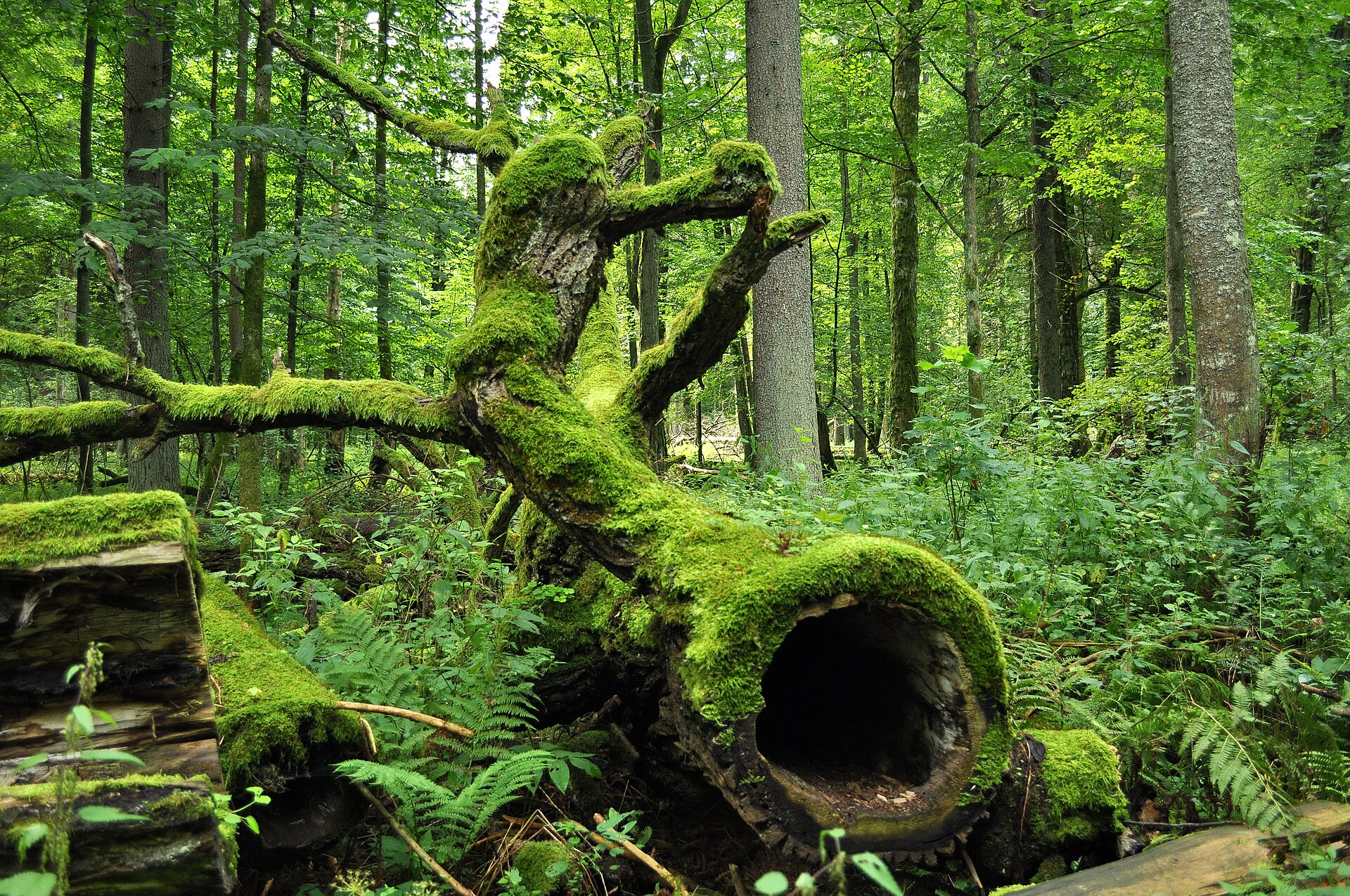
Białowieża protects one of the last fragments of lowland primeval forest in temperate Europe, with its giant oaks, limes and hornbeams and its abundant deadwood. More than half of the park is under strict protection. It is the cradle of the bison's return.
The Tatras are the most visited park and the country's only high-mountain range, with the Polish summit of Rysy (2,499 m). The park is twinned with the Slovak Tatra National Park (TANAP), with which it forms a cross-border biosphere reserve.
Biebrza, the largest national park, protects a valley of marshes and peat bogs that is among the best preserved in Central Europe, and has been a Ramsar site since 1995.
The Słowiński park on the Baltic coast is famous for its shifting dunes near Łeba and its lagoons; it has been a biosphere reserve since 1976.
Bieszczady, in the far south-east, combines primeval beech forests with summit grasslands (połoniny). The park is part of the East Carpathians cross-border biosphere reserve, shared with Slovakia and Ukraine.
Kampinos, on the outskirts of Warsaw, preserves inland dunes and wooded marshes; such proximity to a capital city is rare in Europe.
The Pieniny, with the Dunajec gorge and the Three Crowns (Trzy Korony), is one of the two oldest parks in the country. Karkonosze and the Table Mountains represent the Sudetes.
Among the landscape parks are Suwałki, the country's first, the Barycz Valley, the largest, the Eagles' Nests park in the Kraków-Częstochowa Jura, the Masurian park in the heart of the great lakes, and the Knyszyn Forest park in Podlasie.
Records
The figures below come from GUS (data as at 31 December 2024), unless otherwise stated.
- Largest national park: Biebrza, 59,223 ha.
- Smallest national park: Ojców, 2,163 ha.
- Oldest national parks: Białowieża and the Pieniny, both created in 1932; the protected core of Białowieża dates back to 1921.
- Newest national park: Ujście Warty, 2001.
- Highest point: Rysy (2,499 m) in the Tatra park, the highest point in Poland.
- Most visited park: the Tatras, about 5.1 million visits in 2024 (ministry data).
- Largest area under strict protection: Bieszczady, 20,335 ha.
- Largest landscape park: the Barycz Valley, about 86,300 ha split between Lower Silesia and Greater Poland.
- Smallest landscape park: Miedzichowo, 1,432 ha.
- First landscape park: Suwałki, created on 12 January 1976 (Ministry of Climate and Environment).
Threats
The first threat is structural: with 1% of its territory in national parks, Poland strictly protects only a small share of its habitats, and no park has been created since 2001. Valuable large forests outside the parks, managed by the State Forests, remain open to logging. The emblematic case is Białowieża: in 2016 the Ministry of the Environment authorised a sharp increase in logging in the part of the forest outside the national park, citing a bark beetle outbreak. On a referral from the European Commission, the Court of Justice of the European Union ordered the logging to be suspended in 2017, on pain of a periodic penalty payment, and then ruled on 17 April 2018 (Case C-441/17) that Poland had failed to fulfil its obligations under the Habitats and Birds Directives.
Wetlands are suffering from drying out: old drainage, repeated droughts and falling water tables are affecting Biebrza, Narew and Polesie. Rivers are exposed to pollution, as shown by the Oder environmental disaster of 2022, which killed a large proportion of the river's fish. Major river and maritime infrastructure projects are also debated for their effects on parks, as in the Lower Oder Valley.
In the mountains, overtourism (Tatras, Karkonosze) and spruce dieback linked to climate change and bark beetles pose further challenges. Around the big cities, urban development is eating into the buffer zones, particularly around Kampinos and Wielkopolska. Finally, landscape parks offer weaker protection against construction and major development projects. Climate change, invasive alien species and conflicts linked to the return of large predators complete the picture.
Conservation policies
Conservation relies on the parks' conservation plans, on zoning between strict, active and landscape protection, and on the Natura 2000 network, which according to GUS covers about 16% of the country as special protection areas for birds and 11% as special areas of conservation for habitats (the two partly overlap). Strict protection is increasing slowly: in the national parks it rose from about 64,300 ha in 2000 to 81,400 ha at the end of 2024.
Several recent policies aim to strengthen the system: the ecological subsidy paid to local authorities since 2025, which rewards the presence of protected areas; the proposed 2% levy on State Forests timber sales for nature conservation; and the moratorium on logging in ten high-value forest areas, ordered by the minister on 8 January 2024 and extended until their long-term protection is secured, although its scope was reduced in September 2024 and then by about a quarter in July 2025. The restoration of wetlands, rivers and peatlands is partly funded by EU programmes, under the 2024 EU Nature Restoration Regulation.
As regards species, the wolf remains strictly protected under Polish law (regulation of 16 December 2016 on the protection of animal species, unchanged as of autumn 2026), whereas the Bern Convention and EU law relaxed its status in 2025. The reintroduction and monitoring programmes for the European bison, coordinated notably from Białowieża, are continuing.
New projects
The most advanced project was the Lower Oder Valley National Park (Park Narodowy Doliny Dolnej Odry), south of Szczecin, along the German border. Planned to cover 3,856 ha in an initial phase (the municipalities of Kołbaskowo and Widuchowa and the city of Szczecin), it had secured the agreement of the local authorities concerned and was due to be created on 1 November 2025 according to the government bill (11 November 2025 in the text as passed). Passed by the Sejm on 26 September 2025, the act was vetoed by President Karol Nawrocki on 7 November 2025, on the grounds of the region's economic development, navigation on the Oder and a lack of impact assessments.
The government then chose another route: attaching some 1,400 ha of the Międzyodrze (the land between the two arms of the Oder), in Kołbaskowo and Szczecin, to Drawa National Park, as the “Lower Oder Valley protection district”. A draft regulation of the Council of Ministers, in its version of 22 July 2026, provides for this attachment as well as the addition of some 155 ha adjoining the park, which would bring its area to nearly 12,900 ha; as of 22 October 2026, it had not yet been published in the Journal of Laws. The municipality of Widuchowa and Gryfino district remain in favour of a separate park created by an act of Parliament.
Other projects have long been championed by naturalists without any official procedure being completed: a Jura National Park (Jurajski Park Narodowy) in the northern Kraków-Częstochowa Jura, a Masurian National Park (Mazurski Park Narodowy), a Turnica National Park (Turnicki Park Narodowy, more than 17,000 ha of state forest in the Carpathians, near Przemyśl), as well as the extension of the Białowieża park to the whole Polish part of the forest and the enlargement of the Bieszczady and Karkonosze parks. In July 2026 Greenpeace Poland calculated the revenue that the ecological subsidy would bring to Carpathian municipalities if new parks were created.
Conversely, a bill tabled in the Sejm on 14 April 2026 by members of PSL and Polska 2050 would extend the requirement for municipal council agreement to nature reserves, a move opposed by conservation organisations.
The future of the parks
The future of Poland's parks will be decided first and foremost in the political arena. The local authority veto, followed by the presidential veto of 2025, shows that creating a national park depends as much on local acceptance as on the ecological value of the sites. The ecological subsidy, which makes a hectare of national park financially attractive to a municipality, could shift positions; that is the bet made by the ministry and conservation groups.
The second challenge is financial: the national parks draw about 40% of their resources from their own activities, an unreliable source of income, and struggle to provide the co-financing required for EU funds. The third is climatic: drying marshes, spruce dieback and growing tourist pressure. Finally, the fiftieth anniversary of the landscape parks, which began in 2026, is a reminder that the protection of inhabited landscapes, though less spectacular, covers eight times as much land as the national parks and remains a major lever.
Sources and official data
- Statistics Poland (GUS), “Ochrona środowiska 2025” (2024 data), chapter 5: nature conservation
- Nature Conservation Act of 16 April 2004 (ustawa o ochronie przyrody), ISAP / ELI record (Dz.U. 2004 nr 92 poz. 880)
- Consolidated text of the Nature Conservation Act, Dz.U. 2026 poz. 1315
- Nature Conservation Act of 10 March 1934 (Dz.U. 1934 nr 31 poz. 274)
- Nature Conservation Act of 7 April 1949 (Dz.U. 1949 nr 25 poz. 180)
- Nature Conservation Act of 16 October 1991 (Dz.U. 1991 nr 114 poz. 492)
- Act of 1 October 2024 on local government revenue, ecological subsidy (Dz.U. 2024 poz. 1572)
- Sejm: bill on the Lower Oder Valley National Park (print no. 1721) and legislative procedure
- Sejm: bill amending the Forests Act and the Environmental Protection Act (print no. 2823)
- Ministry of Climate and Environment: protection of the Międzyodrze
- Ministry of Climate and Environment, RDOŚ Łódź: 50th anniversary of landscape parks
- Ministry of Climate and Environment
- General Directorate for Environmental Protection (GDOŚ)
- Court of Justice of the European Union, judgment of 17 April 2018, Commission v Poland, C-441/17
- UNESCO World Heritage Centre: Białowieża Forest
- UNESCO World Heritage Centre: Ancient and Primeval Beech Forests of the Carpathians and Other Regions of Europe
- Białowieża National Park (official website)
- Tatra National Park (official website)
- Pieniny National Park (official website)
- Biebrza National Park (official website)
- EUROPARC Federation