
Features ·
Natural parks in the United States
Home to Yellowstone, often described as the world's first national park, the United States has, as of November 1, 2026, 64 national parks within a system of 434 sites managed by the National Park Service. This article traces their history, from the idea first put forward in 1832 to the establishment of Chiricahua National Park in October 2026, and reviews their status, management, visitation and the challenges ahead.
What counts as a natural park in the United States?
In the United States, the term “natural park” does not correspond to any legal category. The word “park” covers several different realities that need to be distinguished.
At the top are the national parks. They are established by an act of Congress and managed by the National Park Service (NPS), a federal agency within the Department of the Interior. They are generally large areas protected for their scenery, geology or wildlife: Yellowstone, Yosemite, the Grand Canyon, the Everglades.
National parks are only one part of the National Park System, the network of national parks in the broad sense. It comprises 434 “units” with a variety of designations: national monuments, preserves, seashores, recreation areas, historical parks, battlefields, memorials, trails. The NPS notes that these sites, which carry at least 19 different designations, are commonly referred to as “parks.”
At the next level down, each of the 50 states has its own state park system, created and managed under its own legislation. State parks are the closest equivalent to European regional parks, with a focus on conservation and outdoor recreation rather than on the development of an inhabited territory.
Finally, other federal lands protect nature without being called parks: the national forests (193 million acres, about 78 million hectares, managed by the U.S. Forest Service), the roughly 570 national wildlife refuges, the lands of the Bureau of Land Management (BLM, 245 million acres) and wilderness areas, a cross-cutting designation covering more than 111 million acres (about 45 million hectares) spread across these four agencies. This article covers the NPS parks and, more briefly, state parks.
History: from Catlin's idea to the 64th national park
The forerunners. The idea of a park belonging to the nation was born in the West. In 1832, the painter George Catlin traveled up the Missouri River to Fort Union, in present-day North Dakota, to paint the peoples of the Plains. Alarmed by the expected disappearance of the bison and of Native American ways of life, he imagined that “some great protecting policy of government” could preserve these landscapes in “a nation's Park.” The NPS credits him as the first to articulate the idea.
That same year, Congress set aside the hot springs of Arkansas. This Hot Springs Reservation, created in 1832, is sometimes cited as the first federal protected area, but it was a reservation with a utilitarian purpose and became a national park only in 1921.
The first act protecting a landscape for its beauty dates from the Civil War. On June 30, 1864, President Abraham Lincoln signed the Yosemite Grant, which granted Yosemite Valley and the Mariposa Grove of giant sequoias to the State of California on condition that they be held “for public use, resort, and recreation” and remain inalienable. It was not yet a national park, but the principle had been established. This landscape was not empty: in 1851, a volunteer militia authorized by California, the Mariposa Battalion, had entered the valley to drive out the Ahwahneechee, burning villages and food stores.
Yellowstone, 1872. On March 1, 1872, President Ulysses S. Grant signed the act setting aside the region of the headwaters of the Yellowstone River “as a public park or pleasuring-ground for the benefit and enjoyment of the people.” Yellowstone is generally regarded, notably by the NPS, as the world's first national park, with two caveats: the 1872 act speaks of a “public park,” not a “national park,” and other areas had already been set aside, both in the United States (Hot Springs) and elsewhere. Lacking resources, the park was placed under the management of the Army, which took control on August 20, 1886, and handed it over only in 1918 to the first NPS rangers.
Yellowstone was created without the peoples who used the region. The NPS today recognizes 27 tribes with historical and present-day connections to these lands. The Tukudika, a group of Mountain Shoshone, still lived there at the end of the 19th century before being forcibly removed to reservations. The NPS also notes that one of the first superintendents, Philetus Norris, spread the myth that Native Americans avoided the region out of fear of the geysers.
Other parks followed: Mackinac, in Michigan, in 1875, transferred to the state in 1895, then Sequoia and Yosemite in 1890. Yosemite Valley and the Mariposa Grove were returned to the federal government in 1906 and joined the national park.
The Antiquities Act, 1906. On June 8, 1906, Theodore Roosevelt signed the Act for the Preservation of American Antiquities. It allows the President to designate “national monuments” on federal land by simple proclamation, without going through Congress. On September 24, 1906, Devils Tower, in Wyoming, became the first of them. In 1908, Roosevelt used the same law to protect the Grand Canyon, which became a national park in 1919. The act has since been one of the main tools for protection, and one of the most contested.
Glacier National Park, established on May 11, 1910, illustrates another form of dispossession: in 1895, the Blackfeet had sold the mountainous part of their reservation to the federal government, retaining rights to hunt, fish and cut timber. These rights were to last as long as the lands remained public: the federal government considered that the creation of the park ended them, an interpretation the tribe still disputes.
The Organic Act and the birth of the NPS, 1916. By 1916, the Department of the Interior was responsible for 14 national parks and 21 national monuments, with no common administration. On August 25, 1916, President Woodrow Wilson signed the act creating the National Park Service within the Department of the Interior. Its mission is set out in a famous sentence: “to conserve the scenery and the natural and historic objects and the wild life therein and to provide for the enjoyment of the same in such manner and by such means as will leave them unimpaired for the enjoyment of future generations.” Stephen Mather, a businessman, became the first director on May 16, 1917, assisted by Horace Albright, who succeeded him in 1929.
The 1930s. In 1933, an executive order by President Franklin Roosevelt transferred to the NPS 56 national monuments and military sites previously managed by the Forest Service and the War Department: the system opened up widely to historic heritage. In the East, where federal land was scarce, large parks such as Great Smoky Mountains (1934) and Shenandoah (1935) were assembled from land purchased by the states and from private donations, at the cost of displacing their residents: hundreds of families in the Smokies and at least 500 families in Shenandoah, according to the NPS. The Civilian Conservation Corps, a New Deal employment program (1933–1942), built roads, trails and buildings in the national parks and, according to the NPS, helped establish some 800 state parks.
Mission 66 and the question of development. After 1945, the automobile caused visitation to soar in underequipped parks. Director Conrad Wirth launched Mission 66, a ten-year program (1956–1966) funded through annual appropriations, to modernize the parks in time for the NPS's 50th anniversary. The program invented a new type of building, the visitor center, more than 100 of which were built. The program was also criticized: widened roads and large parking lots brought accusations of overdevelopment, as the official NPS history recalls.
The 1960s and 1970s: ecology. In 1963, the Leopold Report, commissioned by the Department of the Interior, recommended managing the parks as ecosystems rather than as scenery. On September 3, 1964, Lyndon B. Johnson signed the Wilderness Act, which created the National Wilderness Preservation System with 54 areas and 9.1 million acres (about 3.7 million hectares); the NPS now manages more than 44 million acres of wilderness. The Land and Water Conservation Fund (LWCF) was created the same year. In 1970, the General Authorities Act affirmed the unity of the National Park System, which by then included urban parks such as Gateway (New York) and Golden Gate (San Francisco) national recreation areas, established in 1972.
ANILCA, 1980. On December 2, 1980, Jimmy Carter signed the Alaska National Interest Lands Conservation Act (ANILCA). The law created ten new NPS units in Alaska and expanded three others, adding 43.6 million acres (about 17.6 million hectares) according to the NPS, which writes that it doubled the combined area of the country's national parks and wildlife refuges. It also broke new ground by guaranteeing rural residents, notably Alaska Natives, the right to practice subsistence hunting and gathering in the parks. This is the origin of Alaska's many preserves, where sport hunting remains permitted.
From 1990 to 2020. In 1994, the California Desert Protection Act turned the Death Valley and Joshua Tree national monuments into national parks. In 1995 and 1996, 31 wolves from Canada were released in Yellowstone, where the species had been eliminated. The 2000s and 2010s saw several monuments upgraded to national parks, such as Pinnacles in 2013 and White Sands in 2019. On August 4, 2020, the Great American Outdoors Act created a restoration fund of $1.9 billion a year from 2021 to 2025 to reduce the maintenance backlog on federal lands, 70% of it for the NPS, and gave the LWCF permanent funding of $900 million a year. On December 27, 2020, New River Gorge, in West Virginia, became the 63rd national park.
2025–2026, a turbulent period. The year 2025 was marked by a sharp fall in NPS staffing, a 43-day partial federal government shutdown in the fall, the longest in history, and an executive order of July 3, 2025, which notably provides for higher entrance fees for international visitors. The NPS celebrated its 110th anniversary on August 25, 2026. On October 20, 2026, Chiricahua National Monument, in Arizona, protected since 1924, became the 64th national park, the first new national park in nearly six years (see our news item on Chiricahua).
State parks, a parallel history. The 1864 Yosemite Grant had already entrusted a great landscape to a state. In 1885, New York State created the Niagara Reservation around the falls; today's Niagara Falls State Park describes itself as the oldest state park in the country. In 1892, the state created the Adirondack Park, which combines public and private land and which its agency describes as the largest publicly protected area in the contiguous United States. State parks multiplied during the 20th century, with a boost in the 1930s from the Civilian Conservation Corps.
Legal framework
Since 2014, the laws relating to the NPS have been compiled in Title 54 of the United States Code (54 U.S.C.). The 1916 Organic Act, codified at section 100101, sets the general mission: to conserve the resources and provide for their enjoyment without impairing them. The General Authorities Act of 1970 and its 1978 amendment apply this non-impairment standard to all units, whatever their designation.
Each park also has its own enabling legislation, which may include specific provisions (subsistence hunting in Alaska, grazing, tribal access to sacred sites). The 2026 Chiricahua act, for example, guarantees tribal members access to the park's cultural and religious sites.
Other laws also apply: the Antiquities Act of 1906, the Wilderness Act of 1964, the Endangered Species Act of 1973, ANILCA (1980), the National Parks Omnibus Management Act of 1998 (which governs studies of new areas) and the Federal Lands Recreation Enhancement Act of 2004 on entrance fees.
Regulations for visitors are set out in Title 36 of the Code of Federal Regulations (36 CFR, parts 1–7), supplemented in each park by a superintendent's compendium.
State parks are governed by the laws of each state: there is no common federal law.
Types of parks and protected areas
As of October 26, 2026, the official National Park System page lists the following categories:
- 64 national parks, the best known, established by Congress;
- 86 national monuments, created by presidential proclamation or by Congress, protecting a natural, archaeological or historic site; other national monuments are managed by the BLM, the Forest Service or other agencies;
- 19 national preserves and 2 national reserves, similar to national parks but where hunting, fishing and even resource extraction may be allowed;
- 10 national seashores and 3 national lakeshores, on the ocean coasts and the shores of the Great Lakes;
- 18 national recreation areas, often around large reservoirs or near cities;
- 4 national rivers, 10 wild and scenic rivers, 6 national scenic trails and 4 parkways;
- 64 national historical parks, 75 national historic sites, 32 national memorials, plus national battlefields and military parks (25 units in total);
- 11 units with unique designations (such as the National Mall or the White House) and 1 international historic site.
Some units carry a dual designation as “national park and preserve,” such as Denali, Wrangell-St. Elias or New River Gorge. The official page also lists sites that are not part of the system but receive NPS assistance: 33 affiliated areas and 55 national heritage areas, lived-in landscapes with a distinctive cultural identity, managed locally, which are the closest thing to French regional nature parks (parcs naturels régionaux).
How many parks?
As of November 1, 2026, the National Park Service manages 434 units covering more than 85 million acres (about 34 million hectares), in all 50 states, the District of Columbia and several territories (American Samoa, Guam, Puerto Rico, the U.S. Virgin Islands), according to its official page updated on October 26, 2026. They include 64 national parks. The most recent unit added is the National Desert Storm and Desert Shield Memorial, in Washington, D.C., on October 24, 2026.
National parks are unevenly distributed: California has 9, Alaska 8, Utah 5, and Colorado and Arizona 4 each. Alaska alone accounts for about 54 million acres of NPS units, or between 60 and 65% of the system's area according to NPS pages.
For state parks, the National Association of State Park Directors (NASPD) counts 9,817 units covering 20.1 million acres (about 8.2 million hectares) and more than 867 million visits a year, without specifying the reference year for these figures. Systems vary widely from state to state: California's, for example, has 280 units according to its 2022–2023 statistical report.
Map
The Parkavela atlas presents the U.S. national parks on the United States page, with their map, and on the world map of protected areas. The NPS, for its part, offers a map search of all units in the system on nps.gov.
Complete list
The list of U.S. national parks described in the atlas, each with a detailed profile, is available in the directory of national parks in the United States. The official list of the 434 units, arranged by category, is published by the National Park Service on its “National Park System” page.
How a park is created
A national park can only be established by an act of Congress, passed by both chambers and signed into law by the President. Most often, the law redesignates a site that is already protected, typically a national monument: this was the case for Pinnacles, White Sands and, in 2026, Chiricahua, after at least five unsuccessful bills; H.R. 6380, passed by the House on March 16, 2026, and then by the Senate, was signed on October 20, 2026.
National monuments follow a different path: the President can create them by proclamation under the Antiquities Act, on land already owned by the federal government, in principle confined to the smallest area compatible with the protection of the objects concerned. Congress can also create them.
Before proposing a new site, Congress generally asks the NPS to carry out a special resource study. The study assesses four criteria set by the 1998 act: the national significance of the resources, their suitability (does the site add something missing from the system?), feasibility (size, cost, land ownership) and the need for direct NPS management rather than management by another entity. According to the NPS, fewer than a third of the studies requested by Congress between 1990 and 2010 concluded that the site was eligible to join the system.
A state park is established under each state's rules, by statute or by a decision of the parks agency, often following a land donation or purchase.
Managing agencies
The National Park Service is part of the Department of the Interior. It is headed by a director nominated by the President and confirmed by the Senate; since January 2025, there has been no confirmed director. The nomination of Scott Socha, put forward in February 2026, was withdrawn by the White House in late April, and the service's comptroller, Jessica Bowron, is exercising the delegated authority of the director; as of October 26, 2026, the official NPS page still listed the position as vacant. Each unit is headed by a superintendent. The NPS says it employs about 20,000 people, including seasonal staff, a figure to be treated with caution given recent cuts (see Funding), and it welcomed more than 131,000 volunteers in 2025.
The NPS relies on many partners: the National Park Foundation, the official charity chartered by Congress in 1967; friends groups dedicated to individual parks; and private concessioners for lodging and food service. Some units are jointly managed: Redwood National and State Parks, in California, are managed together by the NPS and California State Parks.
The relationship with Native nations has evolved toward forms of shared management. Since 1976, the South Unit of Badlands National Park (Stronghold), located on the Pine Ridge Reservation on land owned by the Oglala Sioux Tribe, has been managed by the NPS under an agreement with the tribe; half of the entrance fees collected in the North Unit go to the tribe's parks authority to cover South Unit expenses; this arrangement is still disputed by some reservation residents. In November 2021, a joint order of the Secretaries of the Interior and Agriculture (Joint Secretarial Order No. 3403) directed the agencies to enter into co-stewardship agreements with tribes; in April 2026, an NPS directive on agreements again reaffirmed the service's commitment to strengthening co-stewardship. In August 2024, for example, the NPS signed two agreements with the Miccosukee Tribe of Florida covering Everglades and Biscayne, concluded for five years and renewable for up to 25 years.
State parks are managed by an agency in each state; these agencies are brought together in the NASPD.
Funding
The NPS is funded primarily through appropriations voted each year by Congress. For fiscal year 2026 (October 2025 to September 2026), P.L. 119-74, signed into law on January 23, 2026, provided it with $3.27 billion in discretionary appropriations, including $2.90 billion for park operations, close to the previous year's level. The President's budget request for FY2027 proposed cutting this total to $2.21 billion (down 32%); the bill approved by the House Appropriations Committee in June 2026 provides $3.23 billion. With no full-year law enacted, the NPS is operating at FY2026 levels until December 11, 2026, under a continuing resolution, according to the Congressional Research Service (CRS).
Staffing has fallen sharply. According to the National Parks Conservation Association (NPCA), which analyzed internal Department of the Interior data, the NPS lost about 24% of its permanent employees between January and early July 2025. According to the CRS, the NPS expects a 13% reduction in its full-time equivalents (FTEs) in 2026, partly due to the transfer of functions to centralized services, and the FY2027 request provides for 13,119 FTEs, 18% fewer.
On top of this come so-called mandatory funds. Entrance and recreation fees, governed by the 2004 act, stay 80% in the park that collects them, with the remainder going to parks that do not charge fees. The Great American Outdoors Act restoration fund provided the NPS with up to $1.33 billion a year from 2021 to 2025; bills to extend it (S. 1547, H.R. 9250) have not been passed to date. Despite this effort, the NPS estimated its deferred maintenance backlog at $24.2 billion at the end of fiscal year 2025 (September 2025).
Since January 1, 2026, the “America the Beautiful” annual pass has cost $80 for U.S. residents and $250 for nonresidents. Without a pass, nonresidents also pay a $100 surcharge per person aged 16 and older, on top of the standard entrance fee, at eleven of the most visited parks: Acadia, Bryce Canyon, Everglades, Glacier, Grand Canyon, Grand Teton, Rocky Mountain, Sequoia and Kings Canyon, Yellowstone, Yosemite and Zion. Fee-free days are now reserved for residents.
Missions
The NPS mission stems from the Organic Act: to preserve unimpaired the natural and cultural resources of the system for the enjoyment, education and inspiration of present and future generations. It combines the protection of natural environments and heritage, visitor services, education through the rangers, and scientific research.
The NPS also has responsibilities beyond its parks: it maintains the National Register of Historic Places, administers LWCF grants to states and local governments for their parks, and supports national heritage areas and national rivers and trails.
State parks have a mission more focused on close-to-home recreation: camping, swimming, hiking, while also protecting natural areas and historic sites.
Regulations
In NPS units, the general regulations prohibit removing plants, animals, rocks or archaeological objects and feeding or disturbing wildlife, and strictly regulate camping, fires, pets and off-road travel. In Yellowstone, visitors must stay at least 100 yards (91 m) from bears and wolves and 25 yards (23 m) from other large animals.
Hunting is prohibited in national parks unless the enabling legislation allows it. It is, however, permitted in preserves, under federal and state law. In Alaska, only subsistence hunting by rural residents is allowed in national parks, with sport hunting possible in the preserves. Fishing is generally permitted with a state license.
Since 2014, launching and landing recreational drones has been prohibited in NPS units unless authorized. In wilderness areas, motorized equipment and bicycles are banned.
To manage crowds, some parks require reservations. For the 2026 season, Rocky Mountain kept its timed entry reservations (May 22 to October 12, from 9 a.m. to 2 p.m.), while Arches, Glacier, Yosemite and Mount Rainier dropped their entry reservation systems in favor of real-time traffic management. Some routes still require a permit, such as the Fiery Furnace in Arches.
Local life and economic activity
U.S. national parks are, for the most part, public lands with no permanent residents, unlike European regional parks. Private inholdings remain, notably in Alaska, home to communities that practice the subsistence hunting, fishing and gathering guaranteed by ANILCA.
The main economic activity is tourism. According to the NPS annual report on visitor spending, visitors spent $29.0 billion in 2024 in communities near the parks; including secondary effects, this supported 340,100 jobs and $56.3 billion in economic output nationwide. Lodging is the largest spending category.
Hotels, restaurants and guided activities in the parks are provided by private concessioners: the NPS oversees nearly 500 contracts, which generate more than $1 billion in revenue a year and employ more than 25,000 people in peak season. Grazing, logging and mining are generally excluded from national parks, but some preserves and recreation areas allow broader uses.
Tourism
The National Park System recorded 323,014,305 recreation visits in 2025, according to the NPS, down 2.7% from the 2024 record (331,863,358 visits). The decline came in a year with a 43-day federal government shutdown, during which the NPS kept parks open where possible. Twenty-six units nonetheless set visitation records.
The most visited sites are not national parks: in 2025, the Blue Ridge Parkway (16.5 million visits) and Golden Gate National Recreation Area (15.7 million) came out on top. Among national parks, Great Smoky Mountains is far ahead (11.5 million), followed by Zion (5.0 million), Yellowstone (4.8 million), Grand Canyon (4.4 million), Yosemite (4.3 million), Rocky Mountain (4.2 million) and Acadia (4.1 million). At the other end of the scale, Alaska's remote parks, such as Kobuk Valley or Gates of the Arctic, reachable only by plane, boat or on foot, receive only a few thousand to a few tens of thousands of visitors a year.
This concentration causes overcrowding problems: traffic jams at entrances, parking lots full by morning, congested trails. Several parks tested entry reservations in the early 2020s, before several dropped them in 2026 (see Regulations).
Biodiversity
The system covers a wide range of environments: the tundra and glaciers of Alaska, the temperate rainforests of the Olympic Peninsula, the sequoias of the Sierra Nevada, the deserts of the Southwest, the prairies of the Great Plains, the forests of the Appalachians, the wetlands of Florida, the coral reefs of the Dry Tortugas or American Samoa, the volcanoes of Hawaii.
A few figures give a sense of this richness. The Everglades are home to 36 Florida species on the federal list of threatened or endangered species. In Great Smoky Mountains, an inventory of all forms of life, under way since 1998, has raised the number of species known in the park from about 10,000 to more than 22,000, including more than 1,000 new to science; the park is also a world center of salamander diversity. The Everglades are at once a UNESCO World Heritage Site, a biosphere reserve and a wetland of international importance.
Together with Glacier Bay and two neighboring Canadian parks, Wrangell-St. Elias forms a transboundary World Heritage site of more than 24 million acres (nearly 10 million hectares).
Flagship species
The American bison is the symbol of the parks: Yellowstone is the only place in the United States where bison have lived continuously since prehistoric times. The bison officially became the national mammal in 2016.
The gray wolf was eliminated from Yellowstone in the 20th century, then reintroduced: 41 wolves from Canada and northwestern Montana were released there from 1995 to 1997. Its return is one of the most studied ecological restoration experiments in the world.
The brown bear, known as the grizzly inland, lives in Yellowstone, Glacier, Grand Teton and the Alaska parks; those of Katmai, which catch salmon at Brooks Falls, are famous worldwide.
The California condor, North America's largest land bird, came close to extinction. Pinnacles has been a release site since 2003: the first captive-bred birds were set free there on December 20, 2003, and poisoning from lead ammunition fragments remains the leading threat.
The bald eagle, the national emblem, frequents the coasts and lakes of many parks. The moose inhabits Isle Royale and the Alaska parks, also home to reindeer, known as caribou in North America, and the wolverine. The humpback whale feeds in Glacier Bay in summer.
Among plants, the giant sequoia is the signature tree of Sequoia, Kings Canyon and Yosemite: the General Sherman, with 1,487 m³ of wood, is the largest tree in the world by volume. The saguaro, a giant cactus, and the Joshua tree have given their names to two desert parks.
Major parks
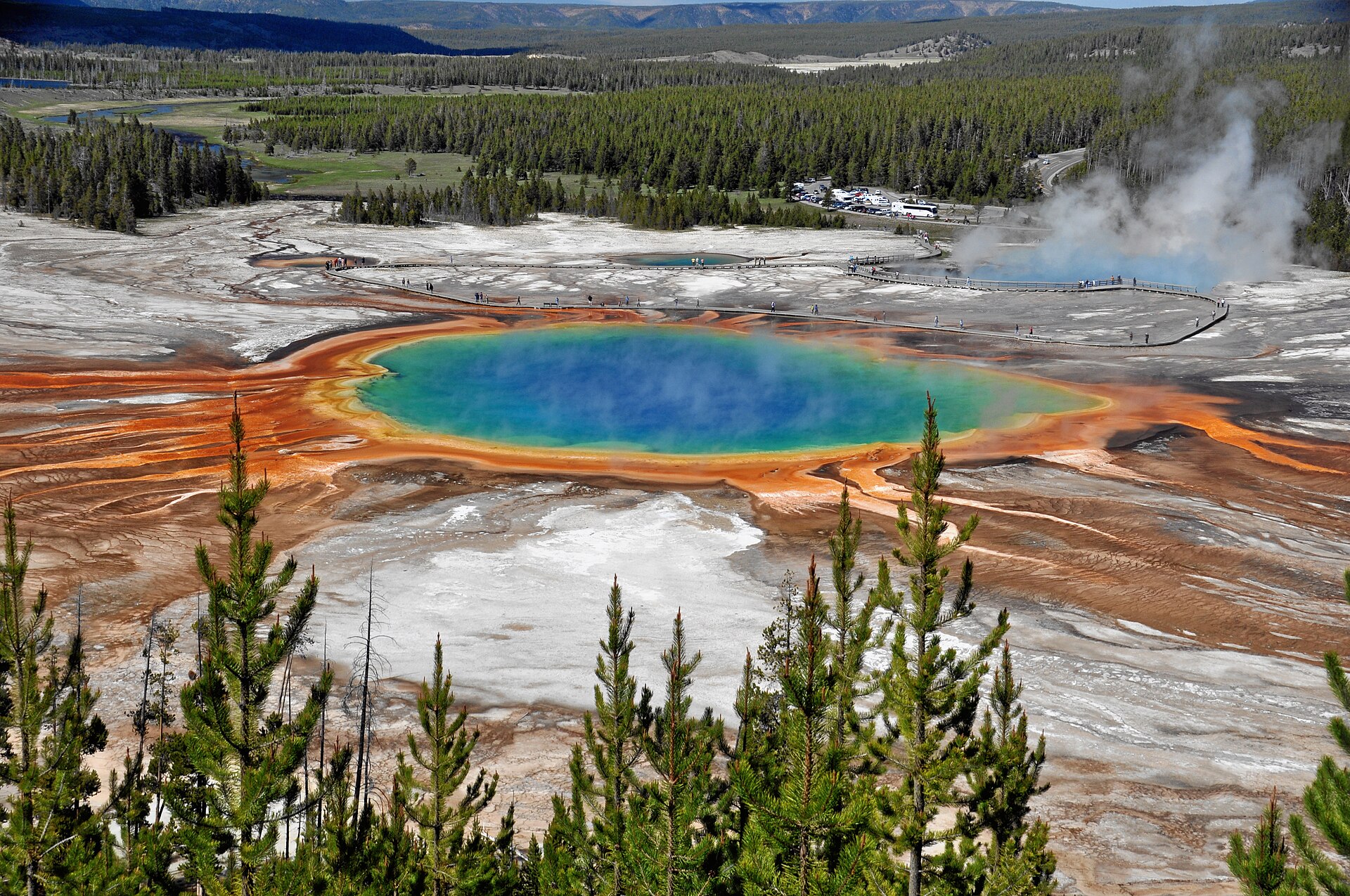
Yellowstone National Park (1872), the oldest, extends across Wyoming, Montana and Idaho. It protects more than 10,000 hydrothermal features, including about half of the world's active geysers according to the NPS, herds of bison and elk, wolves and grizzlies.
Yosemite National Park (1890), in California, is the birthplace of the idea of protection: a glacial valley, granite cliffs, waterfalls and the sequoias of the Mariposa Grove. Farther south, Sequoia National Park (1890) and Kings Canyon National Park, managed together, are home to the largest giant sequoias.
Grand Canyon National Park (monument in 1908, park in 1919), in Arizona, offers the world's most famous geological cross-section, carved by the Colorado River.
Great Smoky Mountains National Park, on the border between Tennessee and North Carolina, is the most visited national park and one of the richest in species.
Zion National Park, in Utah, the second most visited park in 2025, is known for its red sandstone canyons.
Everglades National Park, in Florida, authorized in 1934 and dedicated on December 6, 1947, protects about 1.5 million acres (about 6,100 km²) of marshes, mangroves and flooded prairies: it is the largest subtropical wilderness in the United States and the first national park established to protect biological resources rather than scenery.
Denali National Park, in Alaska, established in 1917 as Mount McKinley National Park and renamed in 1980, surrounds the highest peak in North America.
Glacier National Park (1910), in Montana, has formed with Canada's Waterton Lakes National Park, since 1932, the world's first international peace park; it preserves the memory of the lands ceded by the Blackfeet.
Acadia National Park, in Maine, a national monument in 1916 and then a national park in 1919 under the name Lafayette, was the first national park east of the Mississippi and one of the few created almost entirely from land donated to the federal government.
Chiricahua National Park, in Arizona, the newest, protects about 12,000 acres (about 4,850 ha) of rhyolite columns sculpted by erosion, on the ancestral homeland of the Chiricahua Apache.
Records
- Oldest: Yellowstone, established on March 1, 1872.
- Newest: Chiricahua, which became a national park on October 20, 2026.
- Largest: Wrangell-St. Elias (Alaska), 13.2 million acres, or about 5.3 million hectares, park and preserve combined.
- Smallest national park: Gateway Arch, in St. Louis (Missouri), about 91 acres (37 ha); the smallest unit in the system is Thaddeus Kosciuszko National Memorial in Philadelphia, 0.02 acre (about 80 m²).
- Most visited: Great Smoky Mountains, 11,527,939 visits in 2025; across all units, the Blue Ridge Parkway, 16,533,753 visits.
- Highest point: the summit of Denali, 20,310 feet (6,190 m), the highest in North America, officially renamed Mount McKinley by the federal government in 2025, while the park keeps the name Denali.
- Lowest point: Badwater Basin, in Death Valley, 86 m below sea level, the lowest point in North America.
- Highest temperature: 134°F (56.7°C) at Furnace Creek, in Death Valley, on July 10, 1913.
- Longest known cave in the world: Mammoth Cave (Kentucky), with more than 426 miles (about 686 km) of explored and mapped passageways.
- Deepest lake in the United States: Crater Lake (Oregon), 592 m.
- Largest tree in the world by volume: the General Sherman giant sequoia, in Sequoia National Park.
Threats
Climate change affects the parks more than the rest of the country. A study published in 2018 by researchers affiliated with the NPS showed that national park lands had warmed by 1.0°C per century since 1895, twice as fast as the United States as a whole, because many of them lie in mountains, deserts or the Arctic. In Glacier, only 26 glaciers larger than 0.1 km² remained in 2015, nine fewer than in 1966.
Wildfires, made more intense by drought and fuel buildup, have become a direct threat to species long considered fire-resistant: according to the NPS, the fires of 2020 and 2021 killed 13 to 19% of the world's large giant sequoias. In Death Valley, temperatures of 130°F (54.4°C) were recorded in 2020 and 2021.
Added to these are invasive species, such as the Burmese python in the Everglades, air and light pollution, development on park boundaries and overcrowding.
Finally, the NPS's budget and staffing situation is a recurring concern for park advocacy groups: falling staff numbers since 2025, a maintenance backlog of more than $24 billion, and a proposal to cut the FY2027 budget by nearly a third. According to an internal NPS report from July 2025, cited by the NPCA, ninety parks had reported difficulties due to staff shortages. The FY2027 budget request, for its part, cites an “urgent need to streamline staffing” at the NPS.
The status of national monuments is also contested. In spring 2025, a Department of Justice opinion concluded that the President could reduce or revoke monuments created by his predecessors, a reading of the Antiquities Act disputed by many legal scholars; the monuments targeted are mostly managed by agencies other than the NPS.
Conservation policies
Conservation relies on several tools. Wilderness designation provides maximum protection to a large part of the parks. The Endangered Species Act has made possible landmark recovery programs: the return of the wolf to Yellowstone, condor releases at Pinnacles, the management of bison herds. Fire policy has evolved since the 1963 Leopold Report: prescribed burns and fuel reduction, once rare, are now common tools, and Sequoia and Kings Canyon national parks have undertaken emergency work to protect their sequoia groves.
On a large scale, the NPS takes part in Everglades restoration, a federal and state program designed to restore the natural flow of water in South Florida.
Conservation also relies on land acquisition, funded by the LWCF, and on cooperation with tribes, which bring their traditional knowledge to the management of fire, water and wildlife.
New projects
Other sites hope to follow Chiricahua. H.R. 9416, introduced on June 24, 2026, by two members of Congress from Georgia, would redesignate Ocmulgee Mounds National Historical Park, a place of great importance to the Muscogee (Creek) Nation, as a national park; a House subcommittee held a hearing on it on July 1, 2026. It would be Georgia's first national park.
Congress is also considering extending the Great American Outdoors Act restoration fund, which expired in 2025, and must pass the NPS budget for FY2027. The system is growing mainly through historic units: since 2020, it has added, among others, Emmett Till and Mamie Till-Mobley National Monument (2023), Amache National Historic Site (2024), a former Japanese American incarceration camp, and Carlisle Federal Indian Boarding School National Monument (2024).
The future of the parks
With more than 320 million visits a year, the system remains heavily used, and creating a park still brings both parties together: the Chiricahua act passed the Senate without opposition. Several questions nevertheless remain open.
The first is resources: Congress will have to choose between maintaining appropriations and the cuts proposed by the executive branch. The second is climate: melting glaciers, wildfires, droughts and sea level rise are transforming landscapes that the 1916 act required to be left “unimpaired.” The third concerns visitor management, between open access and regulation. The last concerns the place of Native nations, whose involvement in managing their ancestral lands is growing but remains dependent on political priorities.
Sources and official data
- National Park Service, official National Park System page (number of units and parks, categories): https://www.nps.gov/aboutus/national-park-system.htm
- National Park Service, frequently asked questions (area, staff, volunteers, records): https://www.nps.gov/aboutus/faqs.htm
- National Park Service, recent changes to the system (establishments and redesignations 2020–2026): https://www.nps.gov/aboutus/recent-changes.htm
- National Park Service, Chiricahua National Park: https://www.nps.gov/chir/index.htm
- Text of the Chiricahua National Park Act (H.R. 6380), GovInfo: https://www.govinfo.gov/content/pkg/BILLS-119hr6380eh/pdf/BILLS-119hr6380eh.pdf
- National Park Service, establishment of Yellowstone: https://www.nps.gov/yell/learn/historyculture/yellowstoneestablishment.htm
- National Park Service, tribes associated with Yellowstone: https://www.nps.gov/yell/learn/historyculture/associatedtribes.htm
- National Park Service, origins of the national park idea (Catlin): https://www.nps.gov/articles/npshistory-origins.htm
- National Park Service, quick history of the NPS: https://www.nps.gov/articles/quick-nps-history.htm
- National Park Service, proclamation of national monuments (Antiquities Act): https://www.nps.gov/articles/lee-story-proclamation.htm
- National Park Service, Mission 66 and architecture: https://www.nps.gov/articles/000/mission-66-modern-architecture.htm
- National Park Service, wilderness law and policy: https://www.nps.gov/subjects/wilderness/law-and-policy.htm
- National Park Service, Great American Outdoors Act: https://www.nps.gov/subjects/infrastructure/gaoa.htm
- NPS visitor use statistics (IRMA): https://irma.nps.gov/Stats/
- National Park Service, 2025 visitation highlights: https://www.nps.gov/subjects/socialscience/annual-visitation-highlights.htm
- National Park Service, news release on 2025 visitation: https://www.nps.gov/orgs/1207/03-13-26-2025-visitation-statsitics.htm
- National Park Service, 2024 visitor spending: https://www.nps.gov/orgs/1207/national-park-visitor-spending-contributed-$56-billion-to-the-u-s-economy-in-2024.htm
- National Park Service, nonresident fees: https://www.nps.gov/aboutus/nonresident-fees.htm
- National Park Service, summer 2026 access and reservations: https://www.nps.gov/orgs/1207/national-park-service-expands-access-for-summer-2026-while-maintaining-safety-at-high-visitation-parks.htm
- National Park Service, entrance fees and how they are used: https://www.nps.gov/aboutus/fees-at-work.htm
- National Park Service, concessions: https://www.nps.gov/subjects/concessions/index.htm
- National Park Service, tribal co-stewardship policy: https://www.nps.gov/orgs/1207/national-park-service-issues-new-policy-guidance-to-strengthen-tribal-co-stewardship-of-national-park-lands-and-waters.htm
- National Park Service, Badlands South Unit: https://www.nps.gov/articles/000/south-unit-badl.htm
- National Park Service, wildfires and giant sequoias: https://www.nps.gov/articles/000/wildfires-kill-unprecedented-numbers-of-large-sequoia-trees.htm
- National Park Service, climate change exposure of the parks: https://www.nps.gov/subjects/climatechange/climateexposure.htm
- Congressional Research Service, National Park Service: FY2027 Appropriations (IF13262, September 2026): https://www.everycrsreport.com/reports/IF13262.html
- Federal Register, Executive Order 14314 of July 3, 2025: https://www.govinfo.gov/content/pkg/FR-2025-07-09/html/2025-12775.htm
- Federal Register, Executive Order 14172 of January 20, 2025 (Mount McKinley): https://www.govinfo.gov/content/pkg/FR-2025-01-31/pdf/2025-02096.pdf
- U.S. Fish and Wildlife Service, National Wildlife Refuge System: https://www.fws.gov/story/happy-birthday-refuge-system
- Bureau of Land Management, lands managed: https://www.blm.gov/about/what-we-manage/national
- America's State Parks, National Association of State Park Directors (NASPD): https://www.stateparks.org/about-us/
- New York State Parks, Niagara Falls State Park: https://parks.ny.gov/blog/niagara-falls-state-park-celebrating-140-years-natural-wonder-preserved
- Adirondack Park Agency, about the park: https://apa.ny.gov/about/park.html
- California State Parks, 2022–2023 statistical report: https://www.parks.ca.gov/pages/795/files/Official%202022-23%20STAT%20REPORT.pdf